
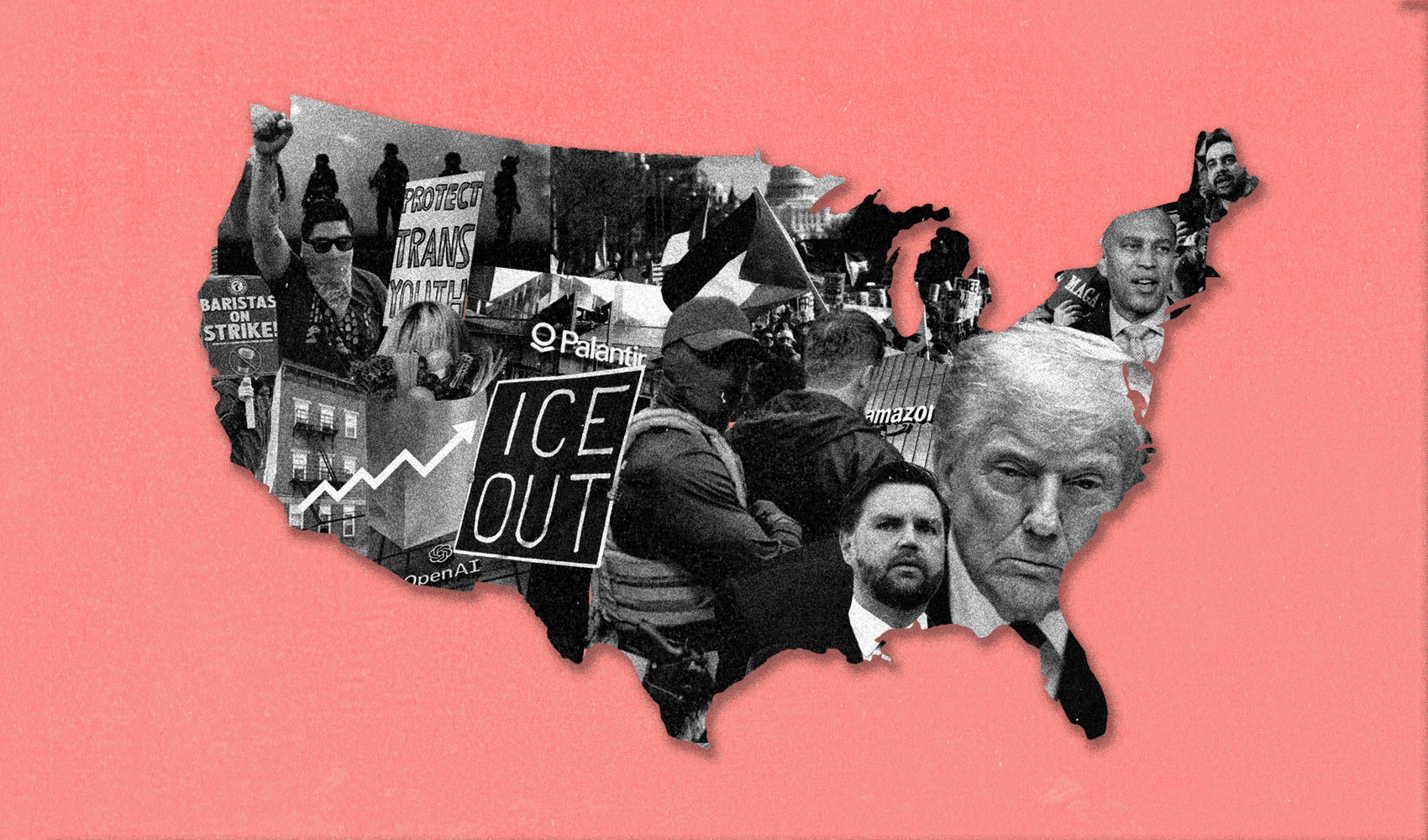
On a yearly basis Black Rose/Rosa Negra engages in a lengthy process of research, analysis, and debate to examine the ways that social, political, economic, and cultural forces are interacting to shape the present moment in the United States. We do this to better position ourselves for intervention, using information we glean to revise our limited term strategy, with the ever-present goal of shifting the balance of forces in favor of the dominated classes.
The process of creating our conjunctural analysis begins at the Local level and flows up through our national Federation. Early drafts of the document you will read below are debated and discussed in advance of our organization’s annual convention. At this national gathering delegates deliver further feedback and critique, after which a final version is drafted and put before the organization’s membership through referendum.
The following is Black Rose/Rosa Negra’s conjunctural analysis for 2025-2026.
Introduction
As revolutionaries, we work to understand our world so that we can act to change it more effectively. Our conjunctural analysis is our understanding of the main forces that are shaping the world, how they interact and contradict each other, and how that defines our current moment. It is not just a static snapshot of everything that has happened in the past year. It is an attempt to capture the dynamic processes that play out across time.
In our first conjunctural analysis in 2023, we identified several key contradictions that are defining this period, such as:
- Mobilization without organization: People are ready to mobilize to protest in large numbers but they are not creating lasting organization.
- Faltering neoliberalism: The hegemony of neoliberal economics is now over but it is not clear what will replace it.
- The polycrisis: Multiple factors are driving crises with increasing frequency and amplitude, creating a period of overlapping “polycrisis”.
- Institutional crisis of legitimacy: The status quo has failed the vast majority of people, leading to a collapse in support for the center and an openness to alternatives on both the right and left, but the Democrats cling to a support for the centrist status quo.
- Empire in decline: US global hegemony is weakening, leading to desperate attempts to maintain imperial power while more space opens up other states to act.
These points still stand, and we believe that there is a great deal of continuity with the current moment, but with an acceleration of previously noted trends and some key changes with Trump’s second term.
With the first year of Trump’s second term showing the growing power of the far-right in an increasingly destabilized world, we can highlight two new points that we believe are key to finding effective action in this moment:
- White Christian nationalism in the driver’s seat: An aggressive white Christian nationalist ideology is driving Trump’s policies, but while the onslaught of attacks have thrown their targets off balance they are also beginning to provoke new resistance and also cracks in the MAGA coalition.
- A decayed social fabric: Generations of economic and technological change are leading to a world where individuals are disconnected, alone, and alienated; creating harsh terrain for social movements but also a widespread yearning for community and social support.
The National Conjuncture
The return of Trump to the Oval Office has struck blows to the national and international order. His administration’s authoritarian nationalist agenda has made strides in eroding the foundations of liberal democracy at home and degrading the so-called “rules-based order” at the international level, fanning the flames of compounding crises shaping the world capitalist system in the name of putting “America First”.
Authoritarianism is on the march in the United States and beyond. Feeding off widespread fear, insecurity, alienation, and anger — symptoms of a crumbling world system facing a deep crisis of legitimacy — it is offering its base a set of scapegoats, violent revenge, the unifying vision of a mythic past, the promise of restoring “traditional values” and social hierarchies, a sense of national pride and hypermasculine, military strength.
In the US, Trump’s brand of authoritarianism has taken the form of an unapologetic white Christian nationalism, unmasking the settler colonial foundation of the country’s founding. His administration has converted a thinly veiled white supremacy into one of the central motivating forces of government policy, even when it conflicts with the needs of major capitalists.
Yet Trump is only the most dangerous and destructive player within an international far-right movement born out of the overlapping crises shaping the globe, from the ecological to the genocidal, reflecting a wide range of reactionary regimes in Israel, India, Italy, Hungary, Argentina and elsewhere.
As Trump and the far-right advance, wielding state power with brute force, the Democratic Party has nothing meaningful to offer. Many mass struggles are beginning to punch back, but more work is needed to grow their strength. Meanwhile, much of the organized left is oriented toward an “inside-outside” strategy — mainly emphasizing the “inside the state” side of the equation — or various flavors of political party-building.
But authoritarian times demand anti-authoritarian politics. Liberal calls to “defend democracy” lead us up a cul de sac. The growing threat of fascism will not be eliminated by defending the same system that created the conditions for its birth, but in fighting the far-right outside and against the state itself — while laying the groundwork for a better world.
Economy: Climbing Costs, Signs of Slump
Trump’s economic policies have exacerbated the growing divide between labor and capital.1 His “One Big Beautiful Bill Act” (OBBBA) combines “the largest upward wealth transfer in American history” with cuts to health insurance and food assistance for the poorest people in the country.2 As many of the “Magnificent Seven” in Big Tech rake in record profits from advertising and increasing investments in Artificial Intelligence (AI), living and working conditions for much of the working class continue to deteriorate.3
This is clear in the rising cost of living. A combination of erratic tariff policy and the Trump regime’s sweeping assault on immigrants has contributed to rising inflation, reflected in recent increases in consumer prices, especially for groceries, gas and medical care.4 Meanwhile rents are on the rise across the country—fuelling record-breaking growth in homelessness—with US median rent prices increasing by nearly 3% in August, the highest since December 2022.5
Along with the uptick in inflation are a set of continuously worsening jobs figures. The unemployment rate recently hit a nearly four-year high of 4.3%, meaning about 7.4 million people are looking for, but cannot find work.6 A recent report from the Labor Department highlighted that weekly applications for unemployment aid spiked from 27,000 to 263,000, also the highest in nearly four years.7 Rising prices and sluggish job growth have raised speculation about a possible recession or “stagflation”— a mix of inflation, a stagnant economy and high unemployment — especially if the growing AI bubble bursts.8
The labor market is especially bleak for Black workers. While the overall unemployment rate hit 4.3%, it surged to 7.5% in August for Black workers, more than double the rate of their white counterparts (3.7%), with Black women disproportionately impacted.9 This stems in part from the Trump administration slashing federal jobs, where Black workers make up nearly 19% of the workforce, along with ongoing attacks on Diversity, Equity and Inclusion (DEI) programs.
The jobs that are being added to the economy are concentrated in healthcare and other industries related to social reproduction—sometimes called ‘human services.’10 While we are likely to see continued growth in this area with increasing demand from an aging population, the “Crisis of Care” that we pointed to in our previous conjunctural analysis is deepening, dramatically accelerated by massive cuts made to Medicaid, SNAP, and other social services passed in the OBBBA, particularly in rural areas of the country. 11
Workers overall have a gloomy outlook on economic conditions. According to a recent poll, 56% of respondents said the economy is “getting worse”.12 The majority used words like “uncertain” and “struggling” to describe the economy with the expectation that prices will continue to rise under Trump, who has done little to alleviate these fears beyond acknowledging their reality on the campaign trail last year. Instead, Trump has concentrated capital in the hands of fewer firms and families, including his own through corrupt crypto ventures and kickbacks.13
Outside of growth in the healthcare sector, unprecedented investment in AI is also serving to prop up the economy.14 In our last conjunctural analysis we pointed to AI as an increasingly important factor, though we focused mainly on its role in driving resource extraction, energy use, and thus climate change.15 Since then, AI has been aggressively integrated into our economic and social lives. The rapid expansion of AI data centers threatens to exacerbate the ecological crisis and raise utility costs, but it has also become a growing site of struggle for local communities seeking to prevent their construction.16
Despite the trillions of dollars being generated or invested in the AI arms race, its tangible impact on worker productivity has been dubious.17 Despite these clearly emerging limitations capital continues to flow to AI firms, suggesting that speculation rather than fundamentals are driving investment and further lending credence to the argument that the sector is in the midst of a bubble.18 AI firms readily admit the precarious economic position that they are in and despite protestations to the contrary, their pursuit of aggressive scaling strategies point to an expectation that the federal government will act as a backstop if and when things fall apart.19
Authoritarianism Advances
Trump and his administration learned their lesson from 2016-2020. They came back prepared. Since returning to office in January, with Project 2025 program in hand, they have been on an unrelenting blitz to reshape society and the state: concentrating ever more power in the executive branch, imposing a white nationalist ideology through key cultural institutions, unleashing troops and ICE agents on cities across the country, and exerting increasing control over the federal bureaucracy.
They have carried out a series of systematic purges designed to transform or eliminate federal agencies, especially those that regard themselves as ‘independent’. Beginning with the so-called ‘Department of Government Efficiency’ (DOGE) under Elon Musk – prior to his fallout with Trump over the summer – on through to the government shutdown, this regime has been on a mission to gut the administrative state and concentrate power in the executive branch.
But while many features of the administrative state have been hollowed out or hobbled, its repressive apparatus is being put on steroids. Trump’s OBBBA provides more than $170 billion for the Department of Homeland Security (DHS) over the next four years, giving it a budget larger than most countries’ militaries.20 $75 billion of this new DHS funding is earmarked for use by Immigration and Customs Enforcement (ICE) to do everything from hiring 10,000 new personnel, to constructing and maintaining massive migrant detention facilities. As well, tens of billions more is broken out for use by Customs and Border Protection (CBP) to further militarize the border.
The express goal of this unparalleled increase in DHS funding is the systematic deportation of at least 1 million people per year, fully in line with Trump’s nativist, racist rhetoric describing migrants as “poisoning the blood of our country” and his calls for “mass deportations”. 21
Since Trump’s inauguration, masked ICE agents have been terrorizing immigrant communities across the country, raiding workplaces, fields, neighborhoods, immigration courts and more to meet their callous quotas. In turn, ICE operations have led to outbursts of popular anger and effective resistance, the clearest example being the combative street protests in Los Angeles during June 2025.22
Responding to nascent popular resistance, Trump has mobilized the National Guard and active duty Marines to assist ICE. While elements of the military have been used on very rare occasions to put down large scale riots in the past, their deployment in response to protests of the size in Los Angeles is unprecedented. A drawn out legal battle has ensued over the legality of the National Guard’s deployment, but has done little to prevent the administration from expanding the practice.
In August, Trump seized control of the D.C. police force, claiming that crime in the city had spiraled out of control despite all evidence to the contrary.23 Soon after, the administration again deployed the National Guard and officers from other federal agencies to patrol the streets of the capitol.24 Trump has since threatened or moved to do the same in other cities, including Chicago, Memphis, Baltimore, and Oakland — all cities with a large Black population and Black, Democratic mayors.
The scale of escalating deportations has wreaked havoc on immigrants and their families, but it has proven profitable for private contractors and foreign governments. Billions of dollars have been doled out in US government contracts to private prisons, airline industries, and the governments of nearly a dozen countries, all reaping the profits from Trump’s xenophobic crackdown on immigration. 25
While some capitalist sectors benefit, a greater number of businesses have suffered economically from ongoing attacks on the super-exploited workforce that they depended on. In June, leaders of the hotel and farming industries asked for exemptions from raids, but after a brief pause the administration reversed its decision, showing a greater allegiance to its white nationalist program than to the immediate needs of capital.26
Trump’s authoritarian agenda, from mass deportations to concentrating power in the executive, has been facilitated by the reactionary majority on the Supreme Court. Similar to Trump’s first term, all of the major efforts undertaken by the administration have been challenged in lower courts, with many now stalled by injunctions. However, while liberals and centrists celebrated these injunctions as victories early in 2025, the administration is now prevailing in nearly every case taken up by the Supreme Court. These include rulings clearing the way for the mass revocation of Temporary Protected Status, deportation of individuals to places other than their country of origin, and ICE’s use of race, ethnicity, or language as “reasonable suspicion” for detentions.27
The Trump administration and its allies are also waging an ideological war, aimed at the influential institutions that shape and reproduce US society: public schools, universities, media outlets, libraries, museums, and research programs. As the right-wing continues to consolidate its hold over mass media outlets, the Trump regime is pushing core cultural institutions to adopt its white nativist ideology.28 In most cases the state has used extortion, threatening to withhold or slash funding, to force these institutions to comply. While some independently wealthy institutions like prestigious private universities have put up minor resistance, most have acquiesced. Surrender has come especially quickly in instances where universities have recognized the opportunity to rid themselves of troublemaking pro-Palestine student organizers.29
The Democratic Party, for its part, remains in disarray a full year after the 2024 presidential election. Until September of 2025, Democrats were content to “play possum” in hopes that Trump’s extreme measures might cost Republicans in the midterm elections. However, growing unrest and outrage at the base of the party are driving it to take a somewhat more proactive approach, mainly by initiating the longest government shutdown in US history.30 Similar to Trump’s first term, Democrats are again falling back on the courts as the primary mechanism to block the administration’s agenda; a losing game as discussed above. Despite belated attempts to satisfy their base, the Party continues to bleed support and faces one of its lowest favorability ratings in decades.31
Despite some turbulence, the MAGA coalition has managed to maintain a tenuous unity by downplaying and managing emerging contradictions — though new cracks have opened in relation to Trump’s refusal to release information about infamous predator and sex trafficker Jeffrey Epstein. Some seized on the hope that Trump’s ouster of Musk as head of DOGE in May 2025 would create a schism within the administration’s coalition. But after a week of trading barbs online (including Musk implying that Trump is a pedophile), the confrontation ultimately fizzled without lasting impact. Challenges from the ‘America First’ faction of Trump’s base over the administration’s bombing of Iran, and to some extent over the genocide in Gaza, have produced only minor cracks in the coalition. Trump has also butted heads with the Federalist Society, a pillar of the legal conservative establishment, for recommending insufficiently loyal judicial appointees, but their relationship remains mostly intact.
One of the most significant internal divisions within the MAGA movement so far has come from its conspiratorial contingent.32 Trump has received significant public pressure for his refusal to make good on a campaign promise to disclose information from a federal investigation into now dead sexual predator Jeffrey Epstein, with whom Trump maintained personal ties. Trump’s refusal to engage on the Epstein issue has driven a wedge in Republican ranks. Far-right and conspiracy-minded congresspeople such as Lauren Boebert and Marjorie Taylor Greene have been made to ‘put up or shut up’ in the midst of a political crisis related to Trump’s refusal to release the so-called ‘Epstein Files’. Ultimately, Trump was forced to concede on the issue and allow passage of a bill clearing the way for the release of information on Epstein. These growing fractures highlight Trump’s status as a lame duck president.
Part of the glue that still holds much of the MAGA coalition together, beyond its rabid xenophobia, is its commitment to reinforcing and reasserting heteropatriarchy. This is most glaring in the growing number of right-wing attacks against trans people. In addition to a series of executive orders aimed at imposing a gender binary, nearly 1,000 anti-trans bills have been introduced in state legislatures across the country since Trump’s inauguration, targeting just about every aspect of trans life, including: bans on ID changes and participation in sports, restrictions on gender-affirming care, bathroom access, and even the right to publicly exist. 33
Driven by the Christian nationalist wing of the MAGA movement, this brutal backlash against recent gains from the queer liberation struggle exploits real and imagined threats to traditional gender norms by tapping into the fear and frustration emanating from overlapping crises at home and abroad.
Weaponizing fear and frustration has been a key tool in MAGA’s playbook, a tactic readily employed in the wake of Charlie Kirk’s assasination. Well before the alleged shooter had been identified, many of MAGA’s most prominent voices, from the President down to the base, took to social media to pin the blame on the “radical left” and whip up calls for vengeance. Regardless of the shooter’s actual motives or politics, the Trump administration quickly began to manipulate the moment in its favor, hailing Kirk as a martyr and exploiting his death as an excuse for escalating political persecution of its opponents, whether through state repression, unleashing its base on manufactured threats or vigilante violence.
Growing violence at home, whether politically motivated or not, is a reflection of growing violence abroad, with US imperialism playing a central role.
The International Conjuncture
The international conjuncture remains marked by the ongoing decline of the US empire and erosion of the ‘international rules based order.’ These trends are evident in the growing number of international conflicts, the rise of China and other BRICS nations, shifting alliances, and the spread of authoritarian nationalism, among other factors that have destabilized the imperial framework established by the US following the Second World War.
In its ham-handed attempts to reassert US global dominance, the Trump administration has undercut many of the institutions that have sustained the empire over time. The administration’s sweeping cuts to federal programs included the dismantling of USAID, a pillar of US soft power that served to mask imperial interests through global humanitarian aid. Abandoning or undermining traditional allies and multilateral institutions like the World Health Organization, the administration is reconstructing US foreign policy to reflect its ‘America First’ principles.
Withdrawing from the US’s longstanding role of managing global capitalism, Trump’s nakedly nationalistic foreign policy has not shied away from intervening in the world. The administration’s tariff policies have disrupted global trade and its cynical claims to being a peace-maker have proven to be flimsy at best. In Gaza, Israel continues to violate the terms of the peace deal, Russia’s war in Ukraine continues, and Trump spent the early months of his administration bombing Yemen and Iran.
The Trump administration has also ratcheted up imperial pressure on Latin America, oppressing its opponents and assisting its allies in an effort to revive the “Monroe Doctrine”.34 The series of attacks by the US military on supposed “drug trafficking” vessels carrying passengers off the coast of Venezuela marks a dangerous shift in imperial strategy in the region, where the Trump administration has threatened to retake the Panama Canal, increased tensions with Colombia, ramped up US military presence in Puerto Rico, and imposed crippling sanctions on an already strained Cuba facing multiple nationwide blackouts. Meanwhile, the Trump administration has awarded lucrative carceral contacts to Nayib Bukele’s regime in El Salvador in support of its mass deportation agenda and offered an open political endorsement and bailout package for the right-wing government of Javier Milei in Argentina, which made gains in recent elections despite facing both political scandals and economic troubles.
Of all its adversaries, however, the US undoubtedly considers China its most serious imperial rival. As US hegemony declines, China has stepped in to claim ever more influence as a geopolitical actor. Whereas the G.W. Bush and Obama administrations pursued strategies of increased focus on and strategic cooperation with China, the first Trump administration initiated a radical pivot toward open imperialist antagonism. But while this rift might increasingly take on a political and military character, above all else it emerges from state competition over access to capital and markets with China and its BRICS alliance gaining ground.
The sharpest edge of the international conjuncture remains in Gaza, where Israel has been enabled by the US to carry on two years of genocidal destruction. By this point Israel has dispensed with feigned justifications for its actions, openly declaring that “there will never be a Palestinian state, this place is ours.”35 Israel has also dramatically expanded the scope of its attacks, carrying out strikes on Lebanon, Qatar, Syria, Iran, and Yemen. World leaders and global institutions have offered little in response to Israel’s ongoing campaign of ethnic cleansing, annexations, regional attacks, and violations of the “peace deal” in place in Gaza.
Israel’s expanding violence in the Middle East reflects growing international conflict and militarism around the world. While Palestine and Russia’s war in Ukraine have dominated headlines, the globe is witnessing the highest number of state-based armed conflicts it has seen in the last seven decades, from the devastating proxy war in Sudan to continuing clashes in Syria.36 Meanwhile, global military spending hit a record $2.7 trillion in 2024 as militarism mounts and global relations between states become increasingly unstable.37
A global wave of uprisings, dubbed the “Gen Z Protests” by media outlets, have shaken political and economic elites from Asia to the Americas. Fueled by deepening economic and social precarity, youth-led mass movements have taken to the streets in Nepal, Peru, Indonesia, Madagascar, Morocco, Kenya, Serbia, the Philippines, and beyond.38 In Bangladesh, Nepal, and most recently Madagascar, militant youth demonstrations have gone as far as toppling the government. Linked together by shared symbols of solidarity drawn from the world of anime, these youth-led struggles signal a significant uptick in class struggle from below in Asia, Africa, and the Americas.
However, much like the Arab Spring before it, many of these protests have succeeded in mobilizing large numbers but lack substantial organization, strategy or a program. In this way, while they have successfully ousted politicians, few durable institutions of popular power have been constructed toward the end of confronting, abolishing, and replacing capitalist and state structures, inevitably allowing another ruling class faction to step in and assume control.
Resistance in the Face of Reaction: Fighting on the Back Foot, but Fighting Back
Resistance to Trump’s authoritarian onslaught has been uneven but growing. Trump’s rapid fire executive orders and demagogic rhetoric put many of his opponents on the back foot. Though slow to find its footing, various forms of opposition are beginning to show significant signs of life as Trump’s approval rating hits its lowest point in his second term.
Some of the most significant flashpoints have emerged in response to excessive overreach from the Trump administration in major cities where the organized left and mass movements have more capacity and will to fight back. The militant protests in Los Angeles marked an important turning point in what was at first a muted response to Trump’s return. The momentum from these initially spontaneous demonstrations has been sustained and given structure by groups such as Unión del Barrio and the Los Angeles Tenants Union (LATU). In particular, LATU’s efforts highlight the potential of mass organizations capable not only of fighting for concessions from bosses or landlords, but of broadening the scope of their struggle when needed. In this way, we recognize LATU to be building and exercising popular power.
While LATU is demonstrating a viable path forward in the fightback against advancing authoritarianism, the tenant movement broadly is at a crossroads. Tenant unions of all types formed and/or experienced success during the social and economic upheaval at the height of the COVID-19 pandemic. This included legacy tenant unions (many of which had long ago ossified into NGO style service projects), ‘autonomous’ tenant unions which emphasize a member-led, direct action, and independent approach, as well as a seemingly new form of tenant union that looks to borrow heavily from the staff supported playbook of contemporary labor unions. Though housing precarity remains a major issue in the US, the acute nature of the crisis during the COVID conjuncture no longer exists. This has left some tenant organizations struggling to retain membership and engage in new fights.
By far the largest response to Trump 2.0 has been the “Hands Off” and “No Kings” protest movements, mobilizing millions across the country in symbolic single-day demonstrations. No Kings is largely led by liberal nonprofits with a handful of labor unions and has mobilized a mostly white, older, and wealthier segment of the population, with calls to protect the very system that produced Trump and others in the global turn toward authoritarianism. Despite its many limitations and contradictions, however, No Kings has been one of the only vehicles capable of mobilizing a wide range of oppositional forces nationwide and opens opportunities for the wider left to build a broad-based struggle capable of stemming the rising far-right tide.
In addition to the No Kings protests, the labor movement mobilized national days of action on May Day and Labor Day, but its ability to fight back has been curtailed both by its own reticence and by a systematic class war from above. In March, Trump issued an executive order that stripped union protections from more than 1 million federal workers, making him the largest union buster in US history. 39The administration’s attacks on unions signals to corporations across the country that it is open season on organized labor. Strikes are down compared to the last several years, union membership continues to decline, and the National Labor Relations Board has been hijacked by Trump appointees.
While weathering these setbacks, some segments of the labor movement are acting with a renewed vitality. New organizing drives have continued in the private sector, strikes and strike threats have yielded important gains, and many unions have incorporated transversal issues such as migrant and Palestine solidarity into their workplace and community struggles. As well, the small but formidable ‘troublemaker’ wing of the labor movement continues to grow, as Labor Notes gears up for what will be its largest ever national conference in 2026. It is likely this fraction will determine whether or not labor becomes a more active force in combating Trump’s authoritarianism.
The resilience of the Palestine solidarity movement has also been remarkable. National conferences, recurring mass protests, and Boycott, Divestment, and Sanctions campaigns have all kept the genocide in Palestine in the spotlight and delivered critical ideological blows to zionism and the legitimacy of Israel’s settler colonial project. This resilience is further illustrated by durable intermediate level organizations and networks emerging from the pro-Palestine struggle. In particular, some chapters of Healthcare Workers for Palestine have developed crucial linkages in and across workplaces to organize healthcare workers against ICE.
Balance of Forces
The balance of forces is tipped in favor of the reactionary right in state power, while nascent popular movements—most notably those in defense of migrants—are beginning to gather strength and forcibly push back. Trump’s ‘flood the zone’ approach yielded success in two major ways: it has so far achieved many of its key objectives and has so far put the centrist and organized left on the back foot. Although the organized left is as large and well organized as it has been in a generation, this has not yet translated into durable, independent mass movements of the scale necessary to tip the balance of power. A broad range of new and old capital, for its part, at first skeptical of Trump’s extreme tariff plans, has since lined up to support the administration’s attacks on unions, massive tax cuts, deregulation, and protectionist favoritism for domestic firms.
In keeping with our assessments in previous conjunctural analyses, we find that the autonomous, street-based elements of the far-right remain marginal. While groups like Patriot Front, Proud Boys, Blood Tribe, and various so-called ‘active clubs’ have made a limited number of dramatic public appearances in the last year, their impact has been mostly negligible. Charlie Kirk’s assassination may put a shot in the arms of these formations or help drive recruitment for Turning Point USA, but it is still too early to make any assessments of those developments.
Anti-fascist organizers active in the 2016-2018 period should continue to receive credit for confronting and destabilizing what was then a serious street-level fascist movement in its infancy. However, the continued demobilization of the autonomous far-right may now be driven, at least in part, by its members’ short-term strategic and tactical alignment with the policies of the Trump administration.
While hardened reactionaries have made their skepticism of Trump known, there is no doubt that they welcome the administration’s sweeping anti-immigrant policies and unvarnished white nativism. More than just passively supporting the Trump administration’s turn toward a more open white nationalism, previously autonomous elements of the fascist right are now being given the unprecedented opportunity to enact their vision from behind a badge. The rapid expansion of DHS and ICE, new norms allowing federal agents to wear masks, a social media recruitment campaign that deploys the aesthetics and language of online fascists, as well as the use of aggressive and previously unseen tactics by said agencies, are all likely to select for ideologically driven recruits eager to round up and purge immigrants.
Whether this means that the roughly aligned short-term visions of the Trump administration and the autonomous far-right will result in the latter dissolving into the former is still yet to be seen—though we find the prospect of total consolidation between the two unlikely.
As noted above, liberals and centrists have failed to chart a path out of the disarray they found themselves in leading up to—and especially after—the 2024 presidential election. Despite recent belated attempts to appease its base by deliberately shutting down the government, the Democratic Party’s crisis of legitimacy has only deepened as its approval rating has ebbed to one of its lowest points in decades.
Some of the more active elements of the Democratic Party base have mobilized street protests with varying degrees of success over the last year. These have included the previously mentioned “Hands Off”, “No Kings”, and Anti-Elon Musk/DOGE protests at Tesla car dealerships. While the latter seems to have had the most tangible material impact, each of these examples are firmly tethered to the Democratic Party and aligned NGOs, limiting their potential to develop as independent mass movements. Still, they represent the largest anti-Trump mobilizations thus far.
Taking a broader view, recent polls suggest that Americans’ view of capitalism has continued to decline over the last four years, while at the same time their view of socialism remains at a historic high.40 Though these kinds of polls tell us very little about how this diminishing or increasing support manifests materially, it does indicate that the continued political and social polarization in the US offers opportunities for intervention. Though the reactionary right is in state power, its ideas are far from hegemonic.
Of note is New York City mayor-elect Zohran Mamdani’s surprise stand out campaign during the city’s Democratic primary. The decisive victory of Mamdani, a member of the Democratic Socialists of America (DSA), has reignited hope in electoralism for reform-minded progressives in DSA and beyond. A politically important post, the fixation on a mayoral office nonetheless reflects a scaling back of the electoral left’s ambition in the aftermath of Bernie Sanders’ failed presidential bids. While the extent to which Mamdami will be able to deliver on his platform is yet to be seen, it remains the case that concessions delivered on the basis of political power have time and time again proven to be fundamentally more vulnerable to reversal than those won and defended via combative class struggle from below. 41The degree that Mamdani’s victory may once again realign the broader left’s strategy toward a focus on electoralism is yet to be seen.
By orders of magnitude, DSA remains the largest socialist organization in the United States. However, the organization is beset by a seemingly endless series of factional disputes. This dynamic was on full display during the organization’s 2025 national convention, where even anti-zionism and BDS were highly contentious issues.42 In recent years DSA has struggled to chart a path for itself without a Bernie Sanders candidacy to cohere behind. Zohran Mamdami—an actual member of DSA, unlike Sanders—seems to be filling that gap for the organization at least partially, increasing the likelihood that its strategy going forward will prioritize elections.
Outside of DSA, there has been noticeable growth in Leninist party-building groups. The decline of a particular sort of anarchist influence on the left after disillusionment with Occupy, the rise of social democratic politics with Bernie Sanders, and the search for a revolutionary alternative to DSA fueled in part by the Palestine solidarity struggle, has contributed to the growth of the Party for Socialism and Liberation (PSL) and the Revolutionary Communists of America (RCA). While even highly visible left groups like PSL claim only a tiny fraction of active movement organizers, giving them a relatively small impact on the overall balance of forces, their attempts to maneuver into positions of structural control within unions and social struggles often place the sectarian interests of their party over building popular power.
A new and highly dangerous development has come in the form of a resurgent McCarthyism, exemplified first by Senator Josh Hawley’s semi-formal inquiries into Unión del Barrio and the PSL for their alleged involvement in LA’s recent anti-ICE demonstrations.43 In the wake of Charlie Kirk’s assassination, Vice President JD Vance wasted no time launching a bloody shirt campaign. Calling the left a “terror network,” Vance has ominously promised to use every mechanism of state power available to initiate a broad crackdown on leftwing organizations—from NGOs to political groups.44 Most recently, Trump has issued an executive order designating ‘antifa’ a “domestic terror organization” and directed the Department of Justice to compile a list of domestic “extremist” groups”, including those who espouse “anti-capitalism” and “radical gender ideology”.45
Reflecting the assessment in our previous conjunctural analysis, we find that the organized left’s relative frailty has left it struggling with the disorganizing effect of Trump’s legislative and policy onslaught. At the same time, the organized left has also proven to be a crucial force in kickstarting and sustaining campaigns, including those related to the Palestine solidarity movement and defense of migrant communities.
Key tasks of the organized left (including organized anarchists) in the present include beefing up legal self-defense capabilities in collaboration with other left groups, building a culture of mass resistance to advances made by the far-right, and reproducing the principles and practices that define the model exemplified by LATU — a commitment to class independence, direct democracy, rank-and-file control, and direct action — within mass organizations around the country. As we have seen, only popular power can stand in the way of the rapid authoritarian advance.
If you enjoyed this read, we recommend our conjunctural analysis for 2024-2025: Crises and Collective Action.
Notes
- https://www.theguardian.com/us-news/2025/nov/03/wealth-billionaires-increase-trump ↩︎
- https://www.theatlantic.com/ideas/archive/2025/05/big-beautiful-transfer-of-wealth/682885/ ↩︎
- https://www.investopedia.com/what-to-expect-from-the-magnificent-seven-in-the-second-half-of-2025-11766435 ↩︎
- https://www.cnn.com/2025/09/11/economy/us-cpi-consumer-price-index-inflation-august ↩︎
- https://www.newsweek.com/map-rents-rise-us-2127390 ↩︎
- It is important to note that the BLS issued unemployment rate does not include individuals who have become discouraged and stopped looking for work after 4 weeks. ↩︎
- https://apnews.com/article/unemployment-benefits-jobless-claims-layoffs-labor-a69fc3afbbebe731c29824b855e3c83f ↩︎
- https://finance.yahoo.com/video/market-talk-recession-stagflation-everything-204116344.html; Despite recent attempts by the administration to disrupt the regular collection and publication of economic data by BLS, working people are clear about the economic strain felt in their everyday lives. ↩︎
- https://www.nytimes.com/2025/10/12/business/economy/black-unemployment-federal-layoffs-diversity-initiatives.html ↩︎
- https://www.wsj.com/economy/jobs/healthcare-job-creation-charts-us-economy-adf2ff89 ↩︎
- The cuts to Medicare alone are expected to increase the number of uninsured by 10 million. See: https://www.cbo.gov/publication/61570 ↩︎
- https://www.cbsnews.com/news/cbs-news-poll-economy-ratings-uncertain-03-09-2025/ ↩︎
- https://www.newyorker.com/magazine/2025/08/18/the-number ↩︎
- https://www.nytimes.com/2025/08/27/business/economy/ai-investment-economic-growth.html ↩︎
- Black Rose/Rosa Negra. Conjunctural Analysis 2025: Crises and Collective Action. https://www.blackrosefed.org/conjunctural-analysis-2025-crises-and-collective-action/ ↩︎
- https://www.npr.org/2025/10/14/nx-s1-5565147/google-ai-data-centers-growth-environment-electricity ↩︎
- Real-Time Population Survey (RPS), a collaboration between the Federal Reserve Bank of St. Louis and Vanderbilt University found a paltry 1.1% increase in aggregate productivity for firms that have adopted AI. ↩︎
- https://www.economist.com/finance-and-economics/2025/09/07/what-if-the-ai-stockmarket-blows-up ↩︎
- https://www.wsj.com/opinion/you-may-already-be-bailing-out-the-ai-business-dd67d452 ↩︎
- https://www.salon.com/2025/07/03/ices-175-billion-windfall-trumps-mass-deportation-force-set-to-receive-military-level-funding/ ↩︎
- https://www.c-span.org/clip/campaign-2024/donald-trump-on-illegal-immigrants-poisoning-the-blood-of-our-country/5098439 ↩︎
- https://abcnews.go.com/US/timeline-ice-raids-sparked-la-protests-prompted-trump/story?id=122688437 ↩︎
- https://www.cbsnews.com/news/dc-crime-data-national-guard-deployments-analysis/ ↩︎
- https://www.whitehouse.gov/presidential-actions/2025/08/declaring-a-crime-emergency-in-the-district-of-columbia/ ↩︎
- https://abcnews.go.com/US/top-private-prison-companies-profits-amid-administrations-immigration/story?id=124591009; https://ig.ft.com/us-deportation-flights/; https://www.cfr.org/article/what-are-third-country-deportations-and-why-trump-using-them ↩︎
- https://www.theguardian.com/us-news/2025/jun/17/ice-raids-farms-hotels-trump ↩︎
- https://www.reuters.com/legal/major-cases-involving-trump-before-us-supreme-court-2025-06-09/ ↩︎
- https://www.whitehouse.gov/presidential-actions/2025/01/ending-radical-indoctrination-in-k-12-schooling/; https://www.theguardian.com/us-news/2025/sep/14/rightwing-news-media-journalism ↩︎
- https://www.dailycal.org/news/campus/uc-berkeley-turns-over-personal-information-of-more-than-150-students-and-staff-to-federal/article_a4aad3e1-bbba-42cc-92d7-a7964d9641c5.html ↩︎
- https://abcnews.go.com/Politics/government-shutdown-timeline-senators-40-day-impasse-sudden/ ↩︎
- https://news.gallup.com/poll/24655/party-images.aspx ↩︎
- https://threewayfight.org/epsteins-ghost-and-the-many-sides-of-conspiracism/ ↩︎
- https://translegislation.com/; https://truthout.org/articles/more-than-850-anti-lgbtq-bills-filed-so-far-in-2025-the-most-in-us-history/ ↩︎
- https://tomdispatch.com/the-trump-corollary/ ↩︎
- https://www.reuters.com/world/middle-east/netanyahu-signs-west-bank-settlement-expansion-plan-rules-out-palestinian-state-2025-09-11/ ↩︎
- https://www.prio.org/news/3616 ↩︎
- https://news.un.org/en/story/2025/09/1165809 ↩︎
- https://www.theguardian.com/commentisfree/2025/oct/12/the-guardian-view-on-gen-z-protests-these-movements-share-more-than-an-interest-in-anime ↩︎
- https://www.epi.org/blog/trump-is-the-biggest-union-buster-in-u-s-history-more-than-1-million-federal-workers-collective-bargaining-rights-are-at-risk/ ↩︎
- https://news.gallup.com/poll/694835/image-capitalism-slips.aspx ↩︎
- https://truthout.org/articles/the-lure-of-elections-from-political-power-to-popular-power/ ↩︎
- See the following tweet for DSA convention voting tallies on resolution to affirm DSA’s commitment to anti-zionism: https://x.com/GoodVibePolitik/status/1954581357302042942?s=20 ↩︎
- https://www.hawley.senate.gov/hawley-launches-investigation-into-organizations-bankrolling-la-riots/ ↩︎
- https://www.politico.com/news/2025/09/15/vance-white-house-promise-to-crack-down-on-radical-left-lunatics-00564766 ↩︎
- https://www.democracydocket.com/news-alerts/doj-terrorism-charges-trump-antifa-executive-order/; https://www.kenklippenstein.com/p/leak-fbi-list-of-extremists-is-coming ↩︎