
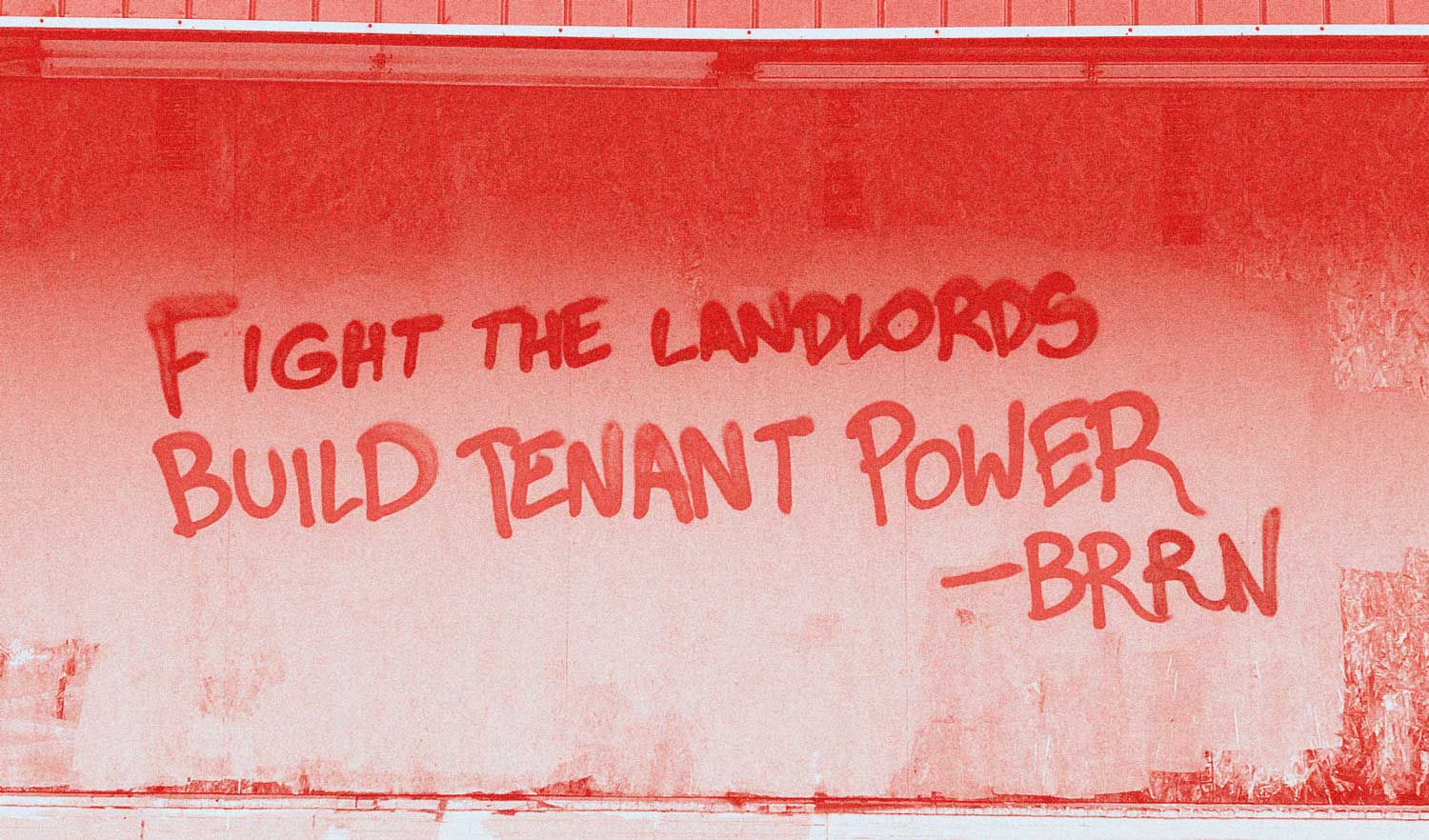
This is the third installment of our Anarchists in the Tenant Movement series. You can find the first installment here and the second here. The interview below was conducted with an organizer named Mario, involved in a tenant union in the US Southeast. We’ve concealed Mario’s specific location at his request.
Like our other series Anarchists in the Labor Movement, these interviews aim to capture insights and perspectives from anarchists who are active in tenant organizing. Some of those we speak to are organizing through established tenant unions, others are building new unions, while others still are launching initial campaigns without a formal union yet.
For Black Rose / Rosa Negra (BRRN), mass organizations like tenant unions play a central role in our strategy. It’s through these kinds of organizations that people create and apply their collective leverage against structures that dominate and exploit us, such as landlordism and private property. By engaging consistently in everyday campaigns members of mass organizations grow their collective confidence and power, enabling them to take on ever bigger fights and ultimately to challenge the very existence of these dominating structures.
In part, the aim of this series is simply to shine a spotlight on the presence of anarchist militants in the U.S. tenant movement. More substantively, we ask participants to critically reflect on their experiences, including both successes and failures, to draw out generalizable lessons.
Most, but not all of those interviewed in this series are members of BRRN.
Answers have been edited for clarity and length.
Mario – Tenant Organizer in the Southeast
Black Rose/Rosa Negra (BRRN): How would you summarize your political beliefs in one sentence?
Mario: I want all people to have autonomy, self determination, and the opportunity to reach their full potential, and I think that’s only achievable through a collective liberation from capitalism, the state, and the social hierarchy that props them up. One sentence is tough!
BRRN: Prior to tenant organizing, did you have any other organizing experience?
Mario: I had done some political activism but nothing that involved convincing people who weren’t already interested in the project to take action or organize together. I started from the direction of organizing for the advancement of black people, mainly with education and things like voter registration drives. I participated in the George Floyd uprisings, and got into anti-policing efforts after that. I also did some mutual aid work, or what’s commonly known as mutual aid (but feels mostly like charity). Both experiences taught me that activists showing up week after week to protest or volunteer doesn’t always transmit to change, and that power doesn’t necessarily flow from large public pressure.
If the only place you interact with people that need aid is at the distro, they continue to only be served at the distro – I noticed often that the people being served were rarely making real decisions or holding power in any way. The closest they got was something like an exit survey asking whether the aid provided was what they needed. I had to step back and process all of it and ended up learning about the tenant union.
I started to research tenant unionism because I’d been interested in labor unions but had never been in a traditionally unionized industry or had a job that felt right to try to unionize, but I’d had plenty of difficulty in tenancy and it seemed like somewhere I could actually do the “mutual” part of mutual aid. The funny thing is that I had participated in multiple walkouts and labor actions that took place outside of a union structure without ever realizing what they were, what they meant or the possibilities that those ruptures could’ve opened up. Even in answering this, I’m just now remembering that they were probably the most militant forms of organizing I’ve engaged in so far.
BRRN: What tenant union are you part of, and about how many people are part of it?
Mario: I’m a member of a tenant union in a mid-sized metro area in the southeast US. We have about 70 dues paying members right now, with a couple of building-level tenant associations.
BRRN: How is your tenant union organized?
Mario: It’s organized into city-based locals made up of building-level tenant associations and at-large members. The locals meet to support each others’ organizing and plan day-to-day activities of the union and make decisions regarding where to spend our time and energy. Members of the locals plus at-large members in the county make up the whole union, and each of these levels makes its decisions in a direct democracy of members.
There are also union-wide committees that carry out essential functions for the growth and development of the union (e.g. an organizing committee), with elected chairs. The elected chairs sit on a committee tasked with putting on the general body meetings and carrying out the proposals or resolutions that are adopted at the general meetings, as well as coordinating across the committees and addressing significant union-wide challenges.
BRRN: What are some of the things you do as a tenant organizer?
Mario: I canvass, have one on ones with neighbors and tenants at complexes we’re helping to organize, give organizing trainings, organize solidarity support for unions and local organizations, and table to find new members and organizing leads. I research and study to find weak points of the local landlords and the municipal structure, as well as learning strategies other tenant unions are using. I also attend and help set up our local meetings and participate in committee and general meetings. Oh, and potlucks: food is part of a lot of our in-person meetings and we’ll have a social every couple months.
BRRN: Describe a campaign you are currently or were most recently involved in: how did it start, what are the main issues, what strategy and tactics are being used?
Mario: We’re starting a campaign against a non-profit landlord. It began when one of their tenants came to a local meeting and started organizing their building, and then another one came and both building organizing drives kicked off. They’ve had some success with just their buildings, so now they are hoping to establish a campaign across all the buildings. The main issues are ignored maintenance and accommodations requests, security and safety issues around building access, and threats of eviction by management. Tactics being used now include petitions and public pressure, but there are planned escalations depending on the results.
BRRN: What resources have helped you the most in developing as a tenant organizer?
Mario: The Madrid Tenants’ Union organizing handbook is a very solid base. It includes everything from how to canvass, run meetings, and escalate a campaign with a lot of insights on how to organize. The Autonomous Tenant Union Network’s “kitchen table sessions,” where organizers from different tenant unions across the country can learn from each other, were great for learning on the ground strategy lessons and connecting with tenant unions organizing under similar conditions. Most of what comes out of Labor Notes is applicable to tenant organizing as well.
BRRN: How do your anarchist politics relate to/inform the day-to-day of tenant organizing work?
Mario: The main way it shows up is in how I view the organizing process. I want wins for tenants, but I want it to actually be the tenants winning. I think this is a common perspective among a lot of people in the tenant movement but it comes out in different ways. To me, it’s about showing up to support and building people up to be the protagonist in their own struggle. It’s being a co-equal participant and not a “community organizer.” It’s sharing knowledge and effort to help people learn to facilitate their own meetings, plan their own actions, and run their own fights. But it’s also fighting in places that aren’t just good targets for organizing, and a belief that I should be struggling forward as well and not just convincing others to do so, in whatever fashion is necessary for those specific conditions.
It also informs the way I approach the union generally. The union began as a project of external organizers, and it really heavily shaped the early character of the organization. In a lot of ways we’ve moved past that, but in others it’s still very present – It’s squarely a leftist organization so I don’t worry too much about us deviating from focusing on the class interests of tenants, but I do worry about where our energy gets focused, how we make decisions and who they are made by, and the distribution of both labor and knowledge within the union.
BRRN: How do tenant unions fit into a broader strategy aimed at revolutionary social transformation?
Mario: When I think about the things that have to change as we build toward social revolution, the first thing that comes up is the fight/flight/freeze stress response. The general responses from tenants seem to be freeze or flight, in that people are mostly accepting the conditions and trying to float or they’re leaving for better conditions. It’s a very common response by tenants: “I’ll just move somewhere else next year.” People don’t know any other way right now, so it’s necessary to develop combative formations to show people that fighting is actually an option, and to show them that they have power and can win those fights.
Tenant unions are a formation where ordinary people can learn and practice class struggle and solidarity. Forming a tenant union and demanding improvements to your conditions either shows people their agency and power or gives them a fight. It helps people make connections between their own experience and struggles and the general economic and political system, and really lays bare the class contradictions between landlords, property management, real estate developers, and the rest of us. In the past week, I’ve heard two tenants ask why the property management neglects tenants and their apartment complexes and then describe what they would do with the place if they were running it. Having a real say in the circumstances of your life and engaging in the struggle to win that say can change the character of people and spur a desire for greater control and agency.
There is also an aspect of prefiguration to tenant organizing, depending on how it’s done. If you build democracy into the union, if you’re running your own fights, solving your own conflicts and developing the knowledge and ability needed for self management, you’re building your revolutionary capacity. If there’s ever going to be a successful transfer of control over housing and land to the people, not only will having these structures in place be necessary to handle management and control of social production, but people will need to be comfortable operating within them.
BRRN: What advice would you share with anarchists looking to organize or become active in a tenant union? What do you wish you had known when you started?
Mario: It depends on if they’re new to organizing generally. If so, I would say to focus on the the concrete tasks of organizing tenants. It’s easy to get caught up in setting up the most ideal system and support projects for the union and miss that the only people in it are the people you started with. There is a lot of information and theory on the best way to carry out “organizing” and building solidarity and confidence for fighting the landlords, but don’t just blindly follow those guides. Commit to a strategy and then bring together the people you tried it with to seriously reflect on its efficacy. Do this even with individual conversations – not in the way of just second guessing yourself, but asking why things you said did or didn’t move the person you were talking to. I wasted a lot of time early on just following the training, failing, and then applying the same training with refined execution, instead of assessing whether the execution or the training was the issue.
For the more experienced organizer, I’d say there is a lot of political interest in tenant unions right now, for better or worse, and so you do need to be aware of the local political ecosystem and how your union interacts with it. It can have a significant impact on the direction of the union, which brings up a second point around small formations vs. established unions. When the union is small, it’s a lot easier to get scooped up in a larger organization’s presence or influence, but it also makes it easier to build in some defenses against that and to build a culture in the union that prioritizes tenant power. It can be a lot to work with, so don’t try to take it all on yourself: your neighbors and the other people in your union are all facing the same issues as you and you can build up trust and shared understanding of what needs to be done that will protect you all as you go on.
Are you an anarchist involved in the tenant movement? Would you like to participate in this series? Email us at eec@blackrosefed.org
Enjoyed this article and want to read more on tenant organizing? We also recommend this brief tenant organizing starter guide.