
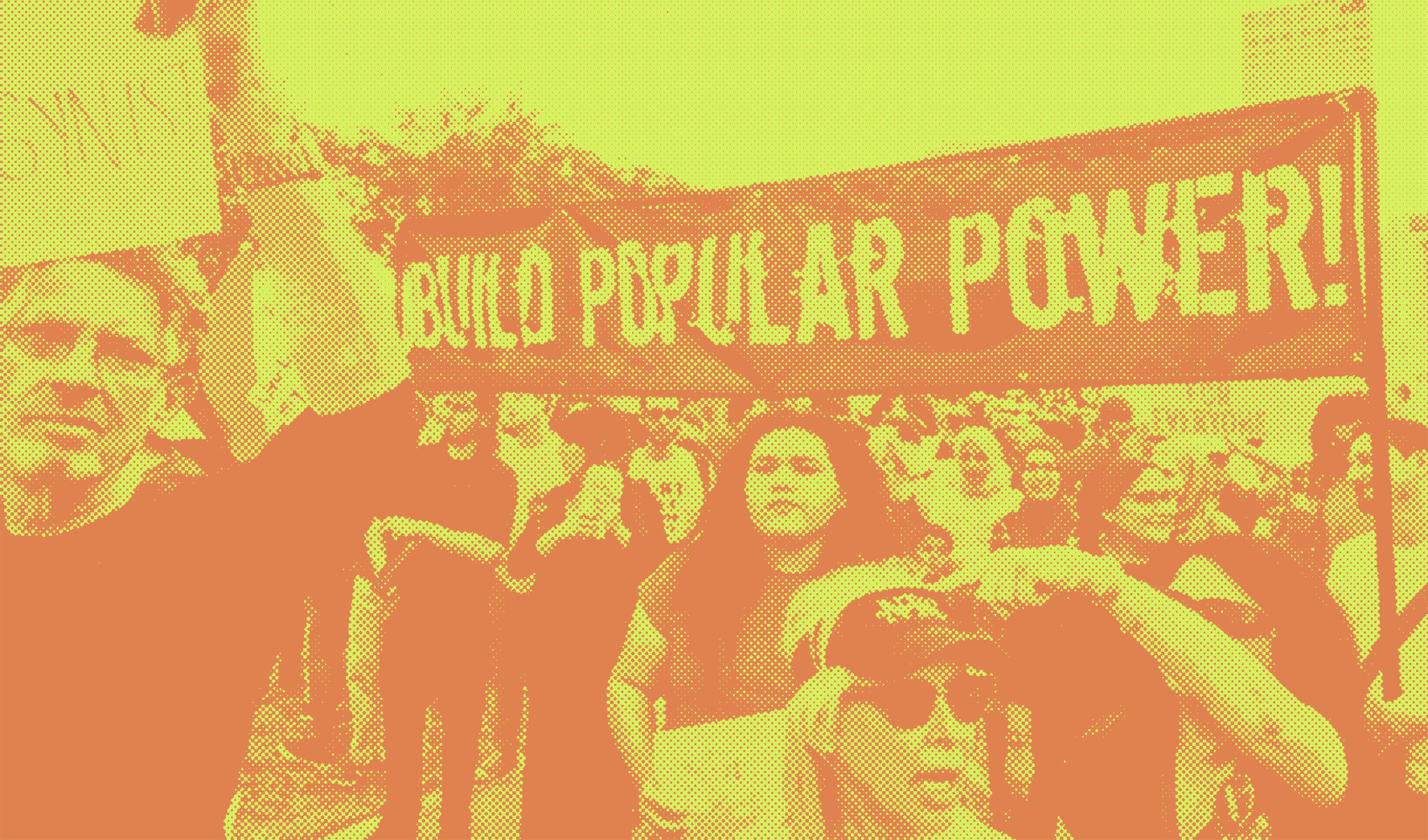
Originally written during the height of the first Trump administration, we’ve returned to this article published by South Florida Resistance to update it for the present moment. This article contains the perspectives of several BRRN members and does not necessarily reflect the collective view of the Federation.
By Patrick Berkman
It is difficult to quantify the sheer amount of chaos, violence, repression, and austerity of the second Trump term, and we are barely more than a year in. Existing crises have grown more severe, while the U.S. government and global capitalist class have unleashed fresh new horrors at home and abroad.
Members of Black Rose/Rosa Negra (BRRN) across the country have been organizing alongside their coworkers, neighbors, and classmates to push back against the actions of this historically unpopular administration and link this present villainy to the systems of domination and exploitation that produce it. None of us has the power to resist individually, but we do have the power to fight back collectively.
Frustration with the status quo is palpable and growing. An estimated eight million people in thousands of cities and towns participated in the most recent series of “No Kings” rallies over the weekend of March 28th. This latest rally was held in the midst of yet another imperialist war waged by the US and Israel in the Middle East, after years of televised genocide in Gaza, and as ICE agents are actively assaulting, kidnapping, jailing, deporting, and killing our neighbors.
These dire developments, witnessed on people’s phones and, increasingly, with their own eyes, are politicizing and radicalizing moments for millions. For example, a Gallup poll in 2017 found that Americans surveyed said that they sided more with Israelis than Palestinians, by 62%-19%. That same poll this February found a plurality siding more with Palestinians for the first time ever: 40%-36%. Anecdotal data from attendees suggest the current US-Israel war against Iran was a galvanizing force for attendance, especially for younger people.
No Kings, “Indivisible” and “50501” protest networks are staffed and financed by Democratic Party officials, donors, and consultants. As revolutionaries, we know they’re not our targets, but many of the people who attend the rallies are. For rally-goers who are motivated afterward to step up and do more, where will their energies be directed: party politics or popular power? And who will present them with that alternative, if not us?
Now is the time to build and strengthen organizations in our schools, neighborhoods, and workplaces to not only resist the agenda of the Trump administration and their outriders, but to take the initiative and pull people toward long-term organizing efforts. There are three ways we can do this, and all of them are necessary:
- Maintain protest mobilizations.
- Criticize the right and put forward alternative ideas more compelling than what liberals and the official left are offering.
- Pull people who are mobilized for protest into long-term organizing efforts.
A Three Pronged Approach
Mass protests critical of Trump’s agenda are useful for bolstering the morale of those who feel alienated and isolated, for symbolically expressing our discontent, and for building connections with others. These are significant in their own right and we need to be willing and prepared to engage with people by putting forward our critiques and perspectives. While the official messaging of a large-scale protest mobilization like ‘No Kings’ is decidedly liberal, by no means is every participant. Indeed, many attend these kinds of mobilizations because they are frustrated and searching for solutions to very real problems. The vast majority of those mobilized don’t possess an analysis that reveals the structural nature of these problems. It’s our role to not only give them that analysis but to arm them with a strategy that goes beyond protest. This kind of engagement must be by speaking with people and building relationship, not simply make speeches or proselytizing indirectly. During a moment of mass discontent like this one, people are more willing than ever to engage with radical ideas and new ways of understanding and acting.
By engaging fellow working class people about our vision for a better world and how we can achieve it, we can win more adherents to our movement and develop our own ideas in the process of dialogue. This can include things like public workshops, informal groups, one-on-one conversations, writings, and (to a much lesser extent) social media. This needs to continue, increase, and take on a serious reflective quality that moves beyond sloganeering and sign waving, toward engaged and prolonged communication.
Electoralists have some of the easiest and most-developed onramps for newly energized people to get involved in political campaigns: join an email list, sign a petition, phonebank, flyer, canvas, donate, vote, etc. While it’s true that these forms of engagement reveal the shallowness of the political project behind them, we still need to build onramps to radical and mass organizing that are just as easy, intuitive, and welcoming. So many people’s reason for doing the bidding of a candidate or liberal nonprofit is that they “just wanted to do something.” Our task is not only to convince the mobilized of why our ideas are superior, but, more crucially, to move them from mobilization to organization.
This requires us to have mass organizations with real campaigns into which the newly mobilized can participate and become rooted in. Students should look toward building real, fighting student unions; workers should organize in their workplaces by building new unions, getting involved in existing unions where they can, and/or building the capacity to act like a union within their workplace where a union doesn’t exist or the existing union doesn’t allow for popular participation; neighborhoods can build assemblies or issue-based groupings around areas that affect them and others around them (from ICE rapid response to housing struggles, from environmental problems to confronting police violence).
Organizing Our Power
With all that’s going on, it often feels like we’re running from one crisis to the next. This scramble leaves us exhausted, frustrated, and often despairing at the lack of gains we’ve made. The antidote to this cycle is to build or become rooted in organizations that build power in the institutions and places that are significant to our everyday lives and to the material functioning of our society.
Mass-level groups, like labor and tenant unions and the connections between them, are the basis for generating the kind of material leverage we need if we want to force concessions from those in positions of power — whether bosses, landlords, or politicians. These organizations must be serious, accountable, and empowering, while also always striving to welcome in new participants. Decisions should be made collectively and democratically by all those involved. We should actively confront oppressive tendencies as a way to build our unity within these groups and be inclusive. These groups should be oriented toward action that’s strategic and independent, with the capacity and willingness to lead by example by breaking from the ineffectual directives handed down by the Democratic Party and non-profit industrial complex. We must act directly to force the hands of the elites where we have power.
We also must act to defend our co-workers and neighbors when ICE descends upon them. From Los Angeles to Minneapolis and in countless other cities, we can learn practical lessons from the diversity of tactics that can be deployed to keep our communities safe. Actions have taken the form of non-cooperation, strikes, boycotts, sabotage, obstruction, community defense and other forms of pushing back strategically, both at the sites of raids and at the sites where we can wield the most power, like our workplaces.
In addition to mass-level organizing at points of production and exploitation, there are hundreds of thousands of activists, organizers and engaged individuals in struggles crossing geography, issue, and economic sector—anti-deportation struggles, reproductive justice movements, indigenous autonomy movements, antifascist/antiracist organizing, environmental justice struggles, queer liberation actions, international solidarity efforts, feminist movement building, and so many more. The continuation of this rotten system is only possible through our labor and acquiescence. We must organize ourselves and build our solidarity, organization, consciousness and capacity to fight collectively. Our own lives, and the lives of people around the globe, depend on it.
Off Instagram, into the Streets
In this process we need to continue with our mobilizations, strengthen our bottom-up collective power, and promote our alternatives to electoralism and other liberal dead-ends that only serve to reinforce this disastrous status-quo. Capitalists, public officials, and those operating within institutions of power will not save us. Only we, collectively, can save ourselves.
It can be easy to feel overwhelmed by helplessness and isolation, but sitting alone with your phone will not solve either problem. Helplessness is cured by being of real service to others. Isolation is cured by making new friends, connections, and comrades. Doing so will require taking risks and leaps of faith. If we believe in the ultimate risk, the ultimate leap of faith — social revolution — we must also recognize that it can only be built through the little risks and little leaps taken by millions of people acting together every week, every day, and every hour.
Taking that first step is how each of us realizes that we were never alone.
If you enjoyed this article and are looking for more discussions on strategy to meet the moment, we recommend our program Turning the Tide.