
Black Rose/Rosa Negra is a revolutionary political organization. This means that we focus our efforts on developing and applying a strategy to build popular power in our workplaces, neighborhoods, schools, and within the state’s prisons.
However, we also recognize the pressing need to recover and transmit our movement’s historical memory. We do this not simply to look back fondly on those who came before us, but to extract lessons still applicable today.
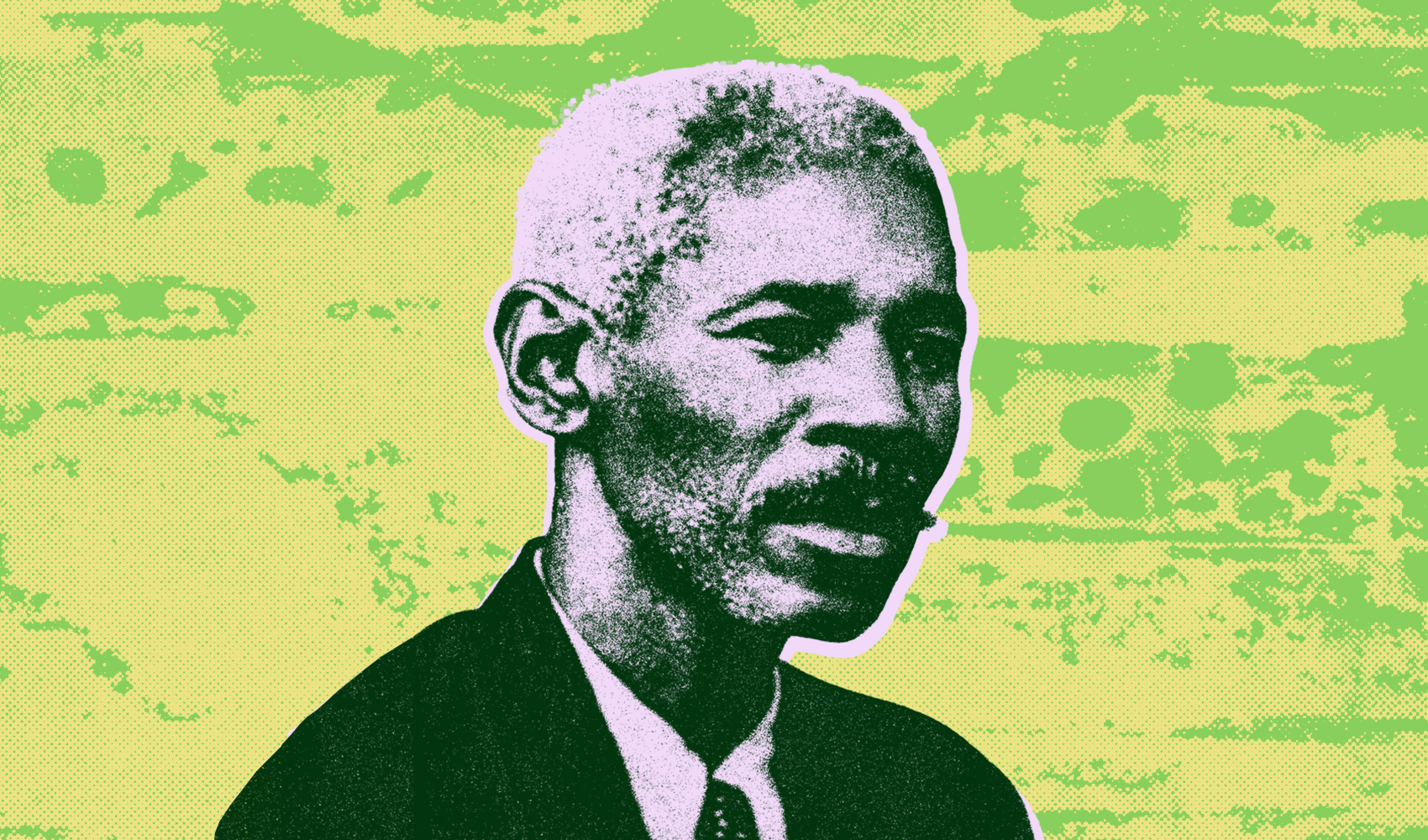
In this spirit we present a brief biography of Rafael Serra, a labor organizer, militant, and leading figure in Cuba’s anarchist movement of the 20th century.
by Enrique Guerrero-López
Born in the town of Bejucal, Cuba in 1884, two years before the abolition of slavery and more than a dozen years before the end of Spanish colonialism on the island, Rafael Serra was a lifelong anarchist and union militant.
At the age of 15, he began working in the tobacco industry, dedicating decades of his life to union organizing in the fields and factories — most owned by U.S. corporations — that defined this key agricultural sector, second only to sugar in Cuba’s economy throughout the twentieth century.
Serra became an anarchist in 1907 in the midst of a six-month long tobacco worker strike and remained an influential figure in the movement for the rest of his life, earning the nickname, “el abuelo,” from fellow militants.
Union Militancy
Serra’s biography reflects anarchism’s deep roots in Cuba’s labor movement.
In 1917, he helped organize the Union de Trabajadores de la Industria del Tabaco in Santiago de Las Vegas, a historic hub for tobacco cultivation. Representing all workers in the industry, the union elected Serra as its president.
That same year, Serra helped found the anarchist-led Sindicato de la Industria Fabril, a fighting union representing industrial workers in candy, soap, paper, and beer factories.
Serra served as union delegate for multiple congresses of the Federación Obrera de La Habana (FOH), an anarchist-led union federation representing various industries in and around Havana.
“I have been involved in the labor movement since 1907, sharing its concerns, its struggles, its triumphs, and its failures.”
Rafael Serra, “2 Entrevistas Relámpago Sobre la Actualidad Nacional,” Solidaridad, May 1946
In 1925, Serra helped found the Confederación Nacional Obrera de Cuba (CNOC), the island’s first nationwide labor federation, representing roughly 200,000 workers.
According to Serra, “libertarian militancy went parallel with union militancy.” He became a prominent propagandist for both movements.
Anarchist Militant: Propagandist
Serra wrote for union and anarchist newspapers on a wide range of topics, from Cuban labor history to race and libertarian socialism.
He wrote for Fabril’s El Progreso and Nuestra Palabra, and Solidaridad Gastronómica (1949-1961), an anarchist-led newspaper run by and for food service workers, to name a few.
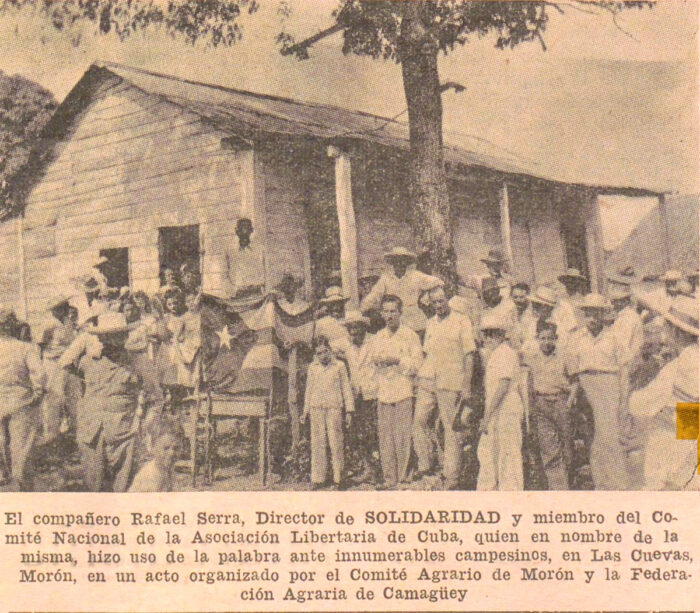
Translation of caption: “Comrade Rafael Serra, Director of Solidaridad and member of the National Committee of the Asociación Libertaria de Cuba (ALC), who, on behalf of the organization, addressed countless peasants in Las Cuevas, Morón, at an event organized by the Morón Agrarian Committee and the Camagüey Agrarian Federation. Solidaridad, July 1947
In the anarchist press, his articles and interviews can be seen in Tierra! (1902-1915), Rumbos Nuevos (1939-1940), Solidaridad (1944-1949), where he served as editorial director, and El Libertario (1952-53, 1959-1961).
Serra also became a familiar face in union halls, mass meetings with peasants in the countryside, and in the anarchist lecture tour circuit.
“There, from racial prejudice, whose roots run deep in history, psychology, and even aesthetics, flows the thousand injustices to which black men and women fall victim. Because of the divisive force of this misguided concern, opportunities in life are closed to us, we are denied entry to certain places, we are often excluded from work; because of it, the irritating differentiation based on skin color persists.”
Rafael Serra, “‘Divide y Venceras’…Politica para Negros,” Rumbos Nuevos, 1940
Asociación Libertaria de Cuba (ALC)
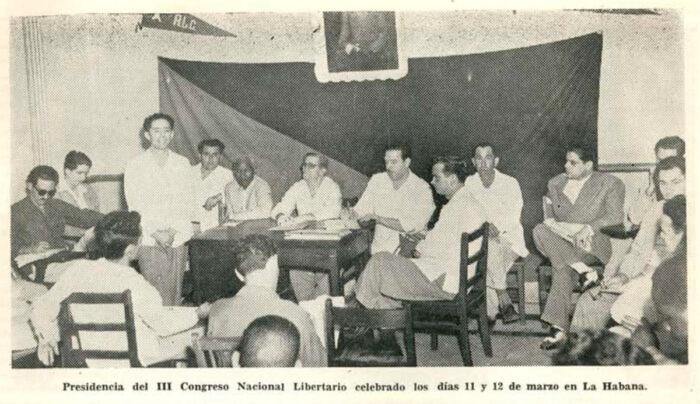
In April 1944, Serra participated in the First National Libertarian Congress in Havana, where militants from across the island founded the Asociación Libertaria de Cuba (ALC).
The ALC rapidly grew into a nationwide anarchist political organization, rooted in the tradition of organizational dualism, with a membership in the thousands. It organized anarchists politically, as members of the ALC, and as a militant minority in mass organizations and movements, including labor, peasant, youth and popular struggles.
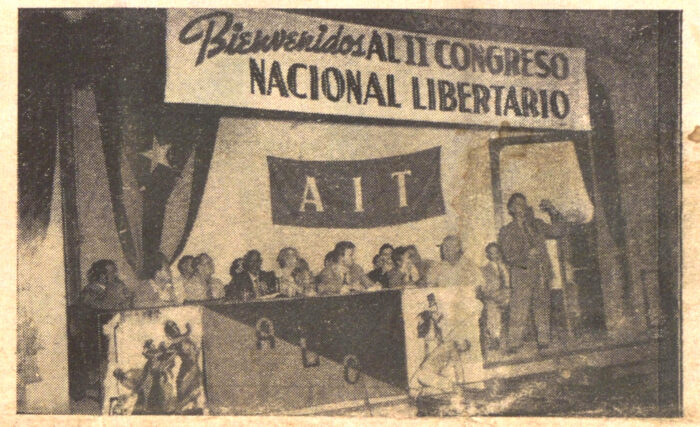
As a movement elder, Serra played a key role in the ALC’s history. Militants elected him as delegate on the ALC’s National Committee, he helped start local branches, assisted comrades in union and peasant organizing, and frequently wrote and spoke on the organization’s behalf.
Anarchist Militant: Historian
Serra’s firsthand experience with many of the key episodes and organizations in the history of Cuban anarchism turned him into a resident movement historian.
In a feature article on the ALC for the popular magazine Bohemia in 1947, the author relied heavily on Serra’s knowledge of the movement to situate the organization within the history of anarchism on the island dating back to the colonial period, noting that his “arsenal of historical references is inexhaustible.”
Through his writings, interviews and speeches, Serra kept the historical memory of Cuba’s anarchist movement alive, highlighting the leading role it played in many of the island’s most important unions and strikes, its organizing among the peasantry, and in sustaining a revolutionary counter culture for decades.
Anarchist Militant: Theorist
Beyond his role as a movement historian, Serra became one of the more prominent anarchist theorists and intellectuals on the island.
Serra was steeped in anarchist theory. In an interview for Solidaridad Gastronomica, when asked about his favorite authors, he mentioned, among others: Peter Kropotkin, Gaston Leval, Rafael Barret, Jose Oiticica, and especially Rudolf Rocker, whose book, “Nationalism and Culture,” made a particular impression on him.
He wrote and spoke about racism, syndicalism, political violence, Cuba’s peasantry and libertarian socialism.
“Socialism,” he wrote, “according to the most logical and sound interpretation of its meaning, means that every human being, by virtue of being born, acquires the right to life, well-being, and culture, without distinction of class, race, or nationality.”
Revolutionary Commitment and State Repression
Serra’s union and anarchist militancy attracted frequent state persecution throughout his life.
In March 1919, he was incarcerated for his role in organizing a tobacco workers strike.
“Revolutions are made by the people, and conscious revolutionary minorities, imbued with the doctrine of liberation, must be constantly alert for the precise moment when the people call for a guide.
Rafael Serra “El Director Opina,” Solidaridad, April 1948
Those who take a step back at the precise moment, instead of placing themselves at the head of the masses, are traitors to the revolution…The red and black flag is just a piece of cloth if we don’t put it at the forefront of the revolutionary movement.”
During the fight against the dictatorship of Gerardo Machado (1925-1933), in which Cuba’s anarchist movement experienced the worst state repression in its history, Serra would again be thrown in jail with countless other comrades in a systematic crackdown on labor militancy.
He was also arrested in the port city of Nuevitas, a historic stronghold of the anarchist movement, for his participation in the general strike of 1934.
During the fight against the dictatorship of Fulgencio Batista (1952-1959), Serra was harassed, beaten and thrown in jail by state police before the Cuban Revolution toppled the regime.
The Cuban Revolution
In March 1952, Fulgencio Batista staged a military coup, putting an abrupt end to Cuba’s Republic and ushering in a brutal dictatorship, backed by the U.S., that would inspire a mass movement across the island, culminating in the triumph of the Cuban Revolution in January 1959.
The ALC fought on all fronts of the anti-Batista struggle, from the urban underground to the armed struggle in the countryside. Serra, now in his 70s, continued to play an active role in the organization and the fight against the dictatorship.
Despite recurring state repression, Serra remained an anarchist throughout his life, spending his final days on the island during the early years of the Cuban Revolution as Fidel Castro’s regime suppressed what remained of the ALC.
If you enjoyed this article, we recommend Organizational Issues within Anarchism as well as, Especifismo: the Anarchist Praxis of Building Popular Movements and Revolutionary Organization