
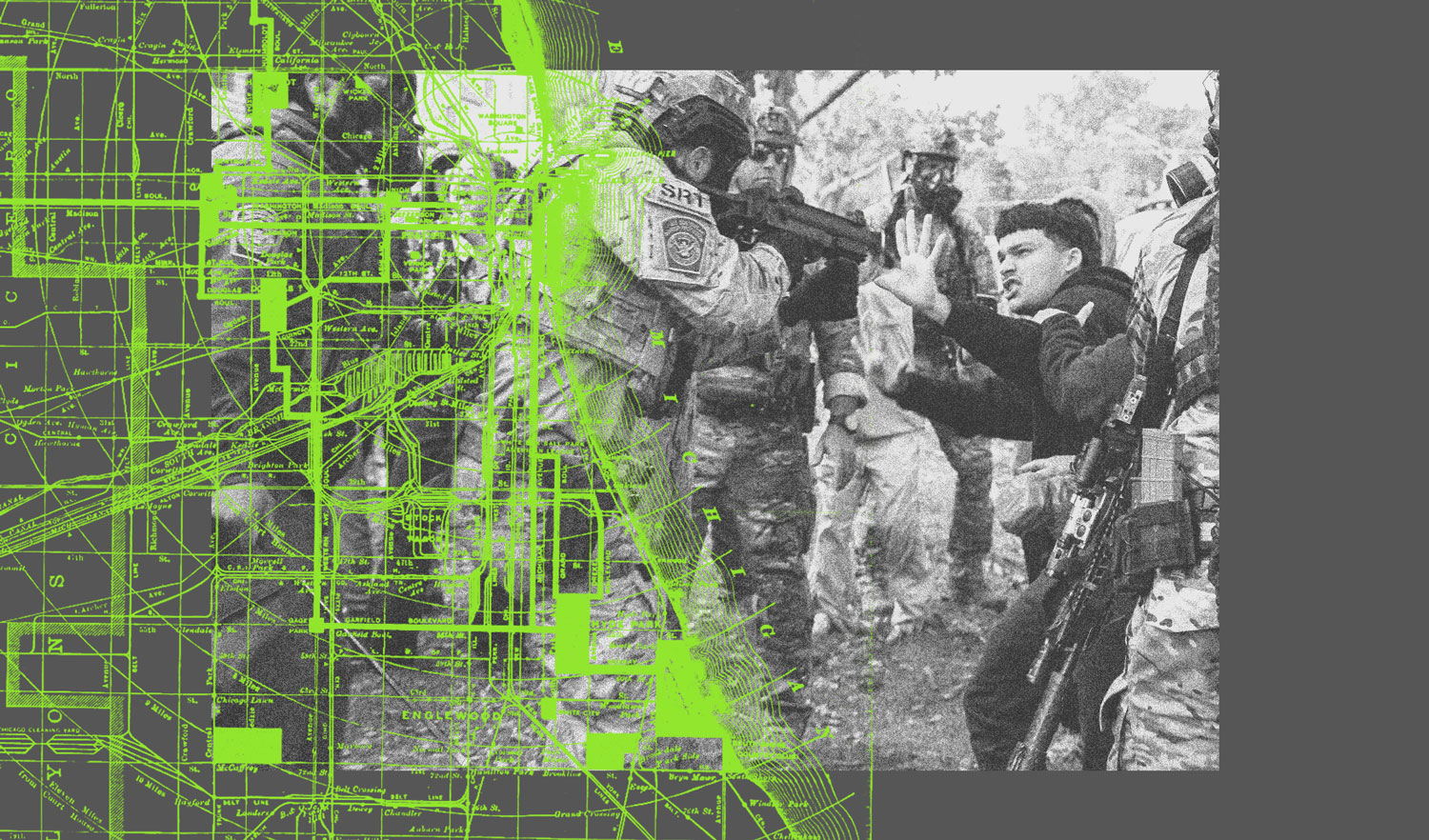
ICE’s invasion of Chicago during Operation Midway Blitz sparked a range of organized community responses, from rapid response teams to fighting detentions at Broadview ICE Facility. In this interview, Heather, a teacher with Chicago Public Schools (CPS) and the Chicago Teachers Union (CTU), reflects on their organizing experiences during that wave of struggle. Drawing on their work in school and supporting a picket line in the Little Village neighborhood, they describe building and mobilizing sanctuary teams while connecting immigrant defense to worker struggle.
This ground-floor recollection shows self-organization in the face of fear, few options for durable collective infrastructure, and uncertainty as to what the deportation siege might bring. It practically outlines the importance of solidarity and connecting struggles across sectors and sites. As the leadership of ICE/Border Patrol continues to change, bringing a lower-key (and successful) tactical shift, we must revisit our approach. This interview provides insights to apply to future struggles against ICE, Border Patrol, and whatever other forms of domination capital and the State throws at us.
Black Rose/Rosa Negra (BRRN): Tell us how you learned about Operation Midway Blitz. What was the sense at your school site and in your district?
Heather: Even before Midway Blitz, immigrant rights organizers in our union had run a training series, during the first Trump administration, about building sanctuary teams in the workplace. Our union also won “sanctuary” language in our contract during a strike in 2019, which set an institutional precedent to turn away ICE whenever legally possible. So, smaller groups of more active members were preparing, even before the surge began.
After, there was a long lead up of news stories where the Trump administration was threatening and attempting to deploy the National Guard, threatening more ICE activity, etc. Our union was already seeing how the National Guard was harassing Black youth in Washington, D.C., and how ICE racially profiled people so blatantly, so among the more active members of our union, we were interpreting this as a direct threat to basically every student and family of color in our school district. During this lead-up, some federal agents showed up at a public elementary school wanting to see a student, and the workers and administrators successfully turned them away, which put the threat and the possibility of defeating it in everyone’s minds. It later came out that it was actually Secret Service agents trying to question the elementary schooler about social media posts, but that didn’t change anything for anyone. So when Midway Blitz began, parents and workers I knew were already fired up to do something about it.
BRRN: How did you and other public school workers prepare for the potential of ICE deployments to your sites?
Heather: At my school, we pulled together a “sanctuary team” that included myself, a security guard, the English Learner Program Teacher (ELPT), and other interested teachers and support staff. I took point on gathering all the resources and examples from my union’s trainings to share with the team. The ELPT had relationships with some of our most vulnerable families, so she was on distributing know-your-rights information to them, and other interested staff were going to do the same to families they had connections with. The security guard is responsible for watching our school’s entrance and he was the only one looped in with our administrators’ implementation of district-wide guidance. At times when the administration delayed implementing the district’s guidance at our school, the security guard was able to push them along, as well as fill in the sanctuary team on any gaps in their plan.
As a sanctuary team, we never had a set plan about how exactly we would respond if ICE showed up. Based on if ICE showed up during recess, drop-off, normal class, after-school, the front or back entrance, etc. our response would have to be completely different. We followed the advice from case studies we got at union trainings: go over general best practices, distribute know-your-rights and rapid response hotline information as widely as possible, think of different response options, and be prepared to communicate quickly if ICE shows up.
Some coworkers and I also flyered parents after school a few times with legal resources, info on the district policy’s protections for immigrant students, and know-your-rights info that applied to interactions with ICE, the National Guard, and the Chicago Police Department. We also worked with our clerks and other parent-facing roles to make sure they knew the full scope of district policies protecting immigrant students.
Throughout all this, we had to combat some misconceptions about which students were vulnerable. Some coworkers thought only our students whose families were seeking asylum from Venezuela were going to be targeted. Many of those students had moved schools over the summer, so they thought we had nothing to worry about. We had to have conversations to explain how many of those families had legal status at the time, but a huge portion of our students might have someone undocumented in their family or they could just be profiled, including not only Latine students but Asian, Arab, and Black students.
BRRN: You also helped with ICE watch at a nearby picket line. Set the scene of the struggle for us and how defense against ICE figured into it.
Heather: A bit over 100 mainly Black and Latine workers at a multinational packaging plant in Little Village called Mauser were striking over dangerous conditions, inadequate protective equipment, low pay, and management’s refusal to incorporate anti-ICE language in their contract. It was a grueling strike; it had already been going on for 3 months when I heard about the ICE watch effort through my union’s communication channels.By then, Mauser was threatening to close the plant because they refused to pay for the repairs needed to make the workplace a safe environment, and the battle was shifting to trying to secure a strong severance package.
By the time I got there, the whole of Little Village was basically under siege as part of Midway Blitz. During some stretches, there were intensive ICE or Customs and Border Patrol (CBP) operations starting early in the morning every day for a week or two weeks in the same neighborhood. “ICE not welcome here” signs were on every block, local restaurants would bring food to the ICE watch volunteers, and more horrifying scenes came out on the news every day. It was just interwoven into daily existence in that area.
To defend the strike, a local workers’ center led an ICE watch effort on the picket line. When I was being trained, the union had secured a location nearby where all the workers would go that they could lock up to buy time as they get the word out and people mobilize to support them and hopefully make ICE back down. As ICE watchers, our job was to stay posted at the intersections with greater visibility so we could warn the workers if ICE showed up. We also tracked some local rapid response channels so we knew what cars to be on the look out for that day and when ICE was heading our direction.
BRRN: Were there issues with ICE or other federal agents surveilling or harassing the picket?
Heather: Once, a CBP or ICE team of 2-3 cars was driving just a block away from the picket, and neighbors were tailing them honking and driving slowly in front of them. At one point an agent pointed a gun or a taser at a driver to make them get out of the way, and ICE/CBP was driving and swerving absurdly dangerously of course. When I saw them, I alerted the workers and they went through with the emergency plan, but CBP or ICE just continued on, so it was a false alarm, which was pretty common.
Agents also showed up to the picket another time when I wasn’t on shift, including Gregory Bovino, who was the public face of Midway Blitz, but they didn’t detain anybody. It seemed like it was more an intimidation or PR move–and a failed one at that since it didn’t break the strike and the picket continued.
Ultimately, the strike ended after several months with the plant getting closed down, but through their collective action, workers secured a pretty good severance deal. The workers, including Mauser truckers who had joined the strike despite not being part of the bargaining unit, also won protections from retaliation for supporting the strike.
BRRN: Drawing from these experiences, what lessons would you like to leave for other education workers who want to protect students and each other?
Heather: The main thing picket line support taught me was the importance of having a plan for turning out public pressure or confrontation with ICE. In a lot of scenarios both there and at my school, ICE/CBP could be outside and you’re kind of trapped inside for some time while agents are trying to get in, which isn’t an ironclad plan. The next step for organizing both at school and the picket line was to help form a tangible plan for how to spread the word publicly or to rapid response networks so that we could mobilize folks ASAP, like a phone tree. That can be especially tricky if you’re worried about ICE activity early in the morning. We started moving in that direction, but never created a plan that would have met the need of those situations.
I would also just say try to organize as early and as broadly as possible. No agents ever showed up at our school. However, the school community is still a powerful place to organize community resistance to ICE. In our school community, that looked like getting know-your-rights information out to as many parents and families as possible, including but not limited to our most vulnerable families. At other schools, that looked like ‘walking buses’ of parents and neighbors walking students to school in large groups, ‘solidarity strolls’ by school workers to watch for any ICE or CBP activity during pick-up and drop-off, and collaborations or mobilizations with neighborhood-based response groups. You want to have a dense web of solidarity — the more people who know what to do when ICE shows up and are organized to communicate, the stronger your entire school community is, whether someone is targeted at school, at home, or in between.
If you enjoyed this article, we also recommend: Healthcare Workers Freed a Patient From ICE – You Can Do the Same and How Teachers, Students, and Parents are Organizing to Keep ICE Out of Durham Schools.