
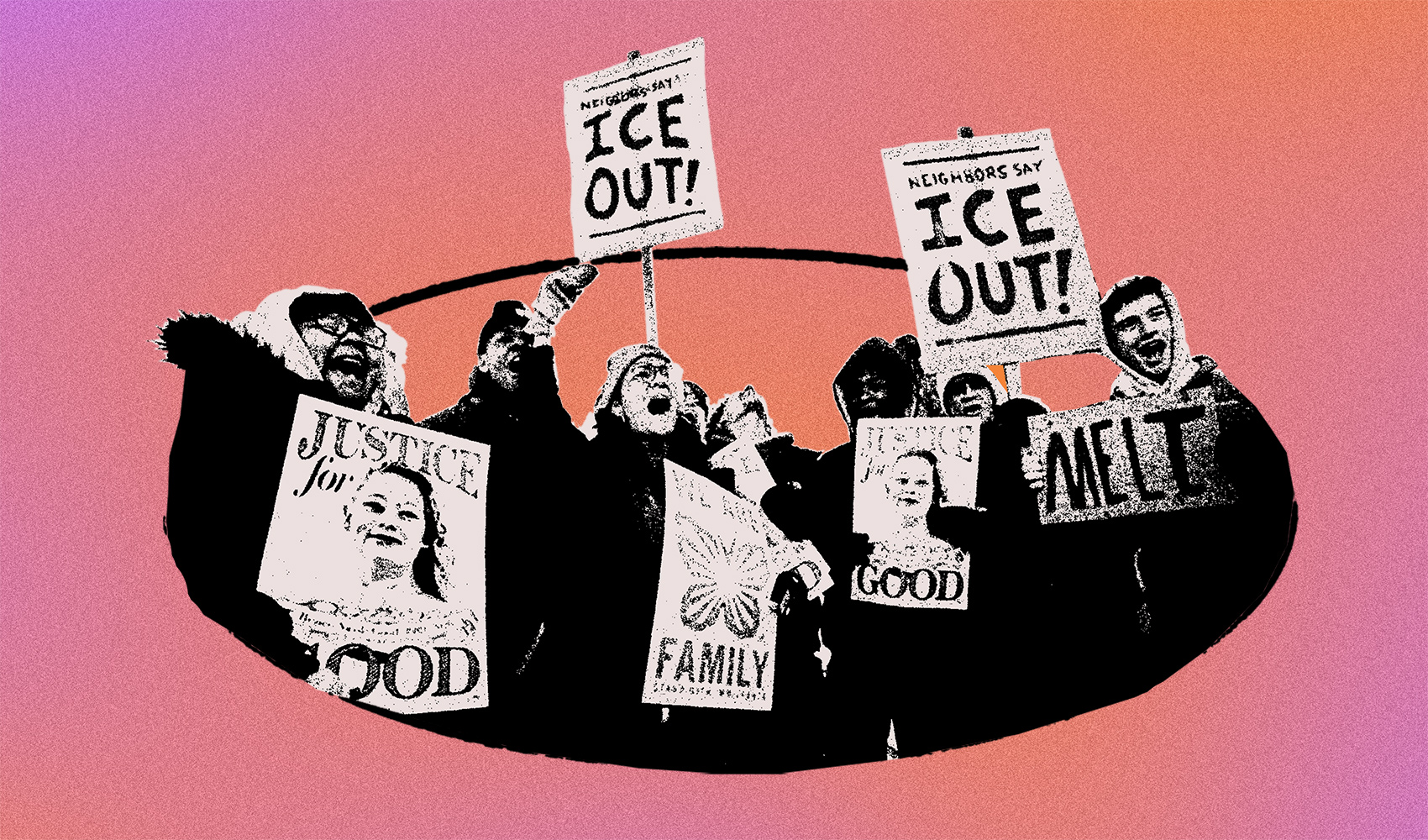
Resistance to state terror, particularly ICE terror, is growing across the country. On January 23rd Minneapolis will be at the forefront of this fightback, launching a city-wide mass strike in response to ICE’s occupation of the city.
Black Rose/Rosa Negra’s (BRRN) External Education Committee (EEC) offers this editorial statement on what appears to be the opening of a new phase in the struggle against ICE.
by BRRN External Education Committee
On January 23rd, Minnesotans will make history with a mass strike demanding ICE out of their city. Teachers, healthcare staff, transit drivers, communication technicians, and other workers will stay off the job; faith leaders will rally congregants into the streets; and rapid response networks will redouble their efforts to thwart ICE from terrorizing Latino and Somali neighbors. Shutting down the city demonstrates the need for large-scale, disruptive direct action to beat back the violent advance of authoritarianism in our workplaces, schools, and neighborhoods.
In Minneapolis and around the country, the George Floyd Rebellion looms large in memory. The burning of the Third Precinct exposed how vulnerable the state’s repressive infrastructure is when confronted by overwhelming numbers. Strategically, however, the Rebellion showed the limits of large scale mobilization, even as it took on an insurrectionary character at times. Mass organizations such as tenant unions and popular assemblies in neighborhoods; student unions in schools; and militant labor unions in workplaces act to embed, sustain, and sharpen diffuse popular fury into popular power.
Without independent mass organizations that allow us to develop our own strategy to determine where social movements go next, even the most antagonistic street movements have shown themselves susceptible to pacification by NGOs, union bureaucracies, and the Democratic Party.
Millions of people disgusted with the Trump administration’s fascist maneuvers have learned vital lessons about sustaining struggle. As we highlighted in our recent conjunctural analysis, spectacular, symbolic demonstrations that released social discontent have been displaced by everyday people developing and expanding infrastructure for defense. Angelinos rapidly spread pioneering responses to National Guard and ICE deployments in Southern California during summer 2025. Chicagoans, Memphians, and now Minnesotans have adapted those tactics, techniques, and strategies to protect their neighbors against ICE surges in their cities.
Rather than standing as fodder for symbolic arrest in front of police lines, people have learned how to throw sand into the gears of state machinery. Direct action blocks ICE from kidnapping their friends and family, and it exemplifies to others how they can shape history. These actions, and others like them, have increasingly gained at least tepid support from local and state officials. Nods to backing mass civil disobedience have only come after everyday people have acted and won. The political class cannot and will not lead us; its members fearfully trail movements they anticipate “getting out of hand.”
By not just declaring, but actually building toward a general strike, workers, neighbors, and students in Minneapolis demonstrate popular power in action. This approach doesn’t rely on political brokers to act on their behalf, nor does it resort to anonymous flyers or social media posts expecting spontaneous social explosions.
A general strike takes sincere, courageous, and widespread solidarity. It takes mass and political organizations – many with which we may share sharp disagreements – working in tandem to turn out their membership and allies to buy nothing, suspend work, and disrupt business as usual. It takes dominated peoples collaborating, stumbling, and striving together.
Nothing should take away from this momentous political occasion. But we would be remiss if we didn’t forewarn that one day of widespread disruption will not throw the brakes on accelerating authoritarianism. Instead, we must sustain widespread disruption and take total control of our cities: our workplaces, neighborhoods, schools, and social institutions, of, by, and for ourselves. How might that look, and what are the steps to expand Minnesotans’ burgeoning power?
Drawing on experiences from the last two decades, including recent work to fight back ICE, we offer the following suggestions and insights we think can carry the budding popular power brewing in Minneapolis one step closer to the social revolution that will rid us of this rot.
- Consolidate organizations for the long term: Like elsewhere, Minneapolis has grown neighborhood-based communications and networks to warn one another about ICE’s presence. Sustaining their efforts will require durable, rooted structures, like neighborhood councils, defense committees, and popular assemblies, that can take up other fights.
Read more about how to build a popular assembly manual and steps for kicking ICE out of your workplace.
- Raise interim demands: Workplace policies that keep out ICE can become longer-term horizons to kick out all police forces. Demanding hotels in our neighborhoods refuse contracts with ICE impedes their ability to operate. Setting clear goals focuses energies to fight like hell and keep on the pressure.
The example of healthcare workers in California demonstrate how to raise, build towards, and win intermediate gains.
- Build a culture of mass resistance: Slogans, propaganda, study groups, and more must reiterate it is us – not bosses, politicians, administrators, or any other member of the dominating class – who can save or take care of us.
Print flyers and pamphlets to share with your friends and in your workplaces, neighborhoods, and schools.
- Grow principled networks of antifascist, anticapitalist, and anti-state resistance: All who stand shoulder-to-shoulder on 1/23 reject the state paramilitaries terrorizing and attacking their communities. The Trump administration’s policies are not an aberration but an outgrowth of the US empire in decay. To stop these forces once and for all, we will need to tear out its roots: capitalist exploitation and state oppression.
Learn how organizing across political divides in the California Bay Area kept out ICE.
Workers, neighbors, and students in Minnesota are navigating uncharted waters in our modern political landscape. Their resolve shows that everyday people can stand down the federal government. As ICE terror surges, we will do all that we can to make one, two, a thousand coordinated stands in Minneapolis and wherever the state reaches its hands, and we can beat it back, once and for all.