
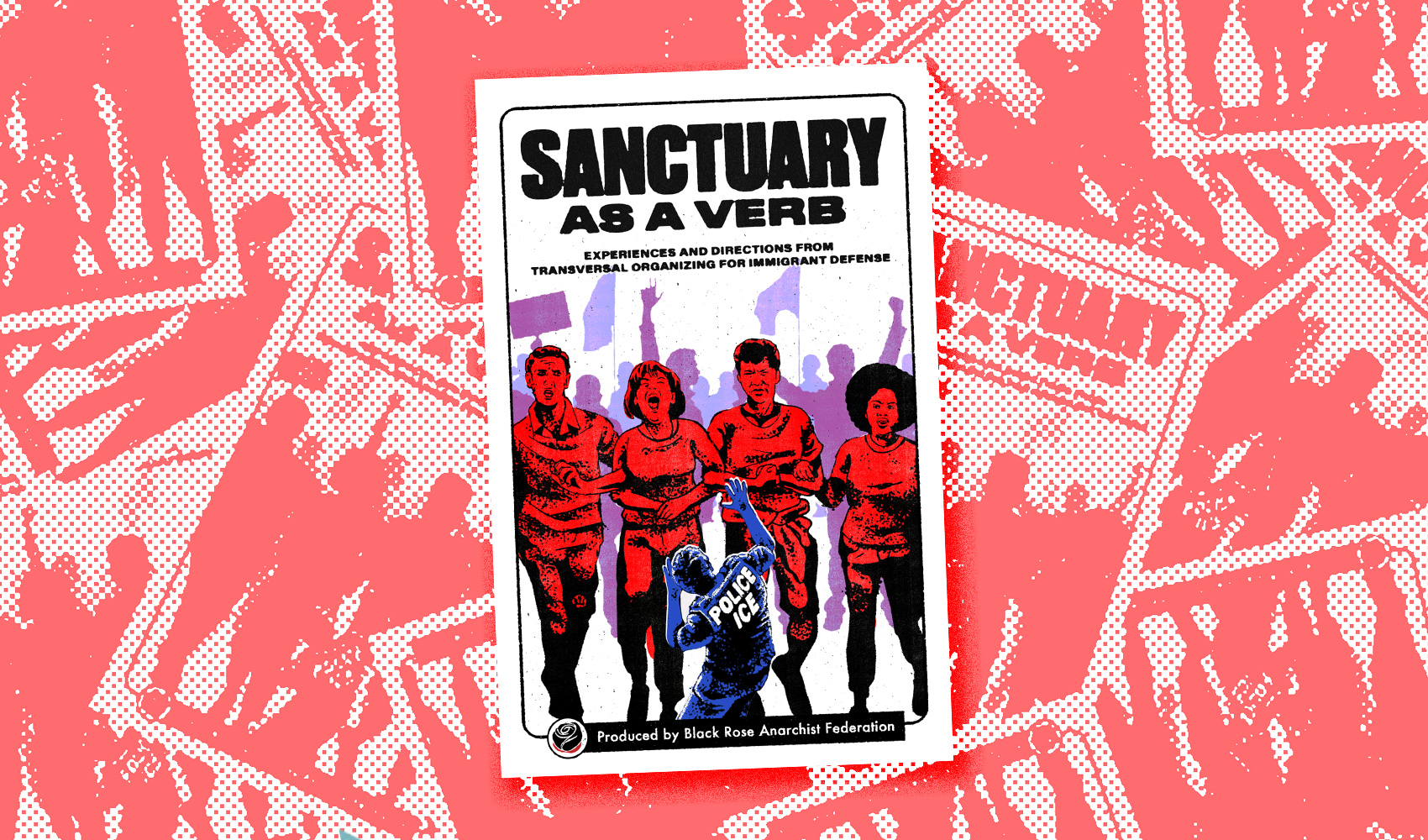
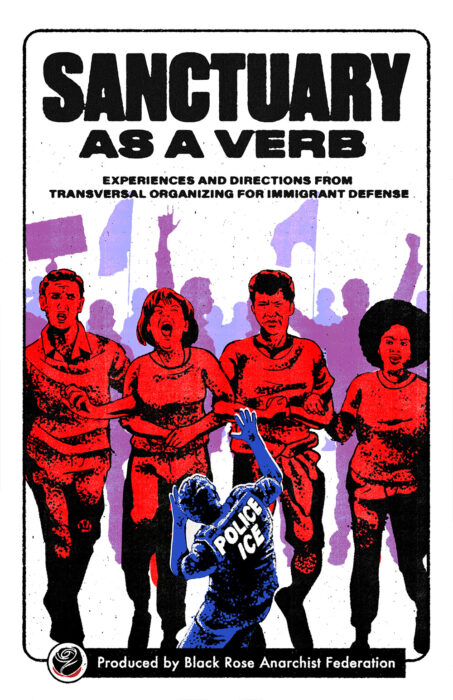
Black Rose/Rosa Negra Anarchist Federation (BRRN) is excited to announce the publication of Sanctuary as a Verb: Experiences and Directions from Transversal Organizing for Immigrant Defense.
Drawing on organizing experiences of Black Rose/Rosa Negra members across the United States, this pamphlet explores how workers, neighbors, and communities are building collective resistance to ICE and defending their immigrant coworkers, classmates, and loved ones. By connecting struggles across workplaces, schools, and neighborhoods, the transversal organizing approach we prioritize builds solidarity across different sectors of society to confront the interconnected structures of domination that shape our lives.
You can find a downloadable PDF version of the pamphlet at the end of this text.
Two Years of Trump II: Immigrants in the Crosshairs, Resistance Under Attack
Upon returning to office, Donald Trump wasted little time fulfilling his white supremacist campaign pledge of “Mass Deportations Now.” Via a flurry of executive orders and congressional acts his administration reinstated the reviled “family separation” policy; directed virtually unlimited resources to stop a fictitious “invasion” of the country’s borders; and sought to end birthright citizenship. Immigration and Customs Enforcement (ICE) agents blitzed Los Angeles in June 2025 with spectacular raids, followed shortly by similar operations in dozens of cities across the country including New York City; Chicago, IL; New Orleans, LA; and Durham, NC. This “shock and awe” strategy culminated in Operation Metro Surge, a months-long invasion of the Minnesota Twin Cities that deported over 2,000 residents.
Meanwhile, support for the deportation machine plummeted as collective action against it swelled. Everyday people covered their cars, lawns, and lips with the slogan “Abolish ICE;” as of July 2026, nearly 50% of US adults support such a measure. Both May Days since Trump’s second inauguration centered immigrant defense in their celebrations. Rapid-response networks that keep watch for ICE, document kidnappings, and sometimes disrupt them spread wildly. Know-your-rights training flourished at worksites and community centers. Millions of Red Cards–wallet-sized cards outlining the holder’s constitutional protections around interactions with ICE and other police–were distributed at schools, churches, restaurants, and municipal buildings. Children and their parents caged in concentration camps went on hunger strike as constituents bombarded politicians’ hotlines and town halls demanding humanitarian treatment and release outside their walls.
Popular responses in St. Paul and Minneapolis demonstrate the possibilities of mass resistance. Like the Los Angeles Tenant Union’s community defense centers that countered ICE’s Southern California invasion, organizers reactivated dormant neighborhood networks from the 2020 uprising and began building new ones when word spread that Commander-at-Large Greg Bovino was bringing his paramilitary forces to town. Once Operation Metro Surge launched, everyday Minnesotans refined sophisticated systems to track, delay, and disrupt arrests. ICE agents retaliated by killing rapid-responder Renée Good and shooting Julio C. Sosa-Celis, a Venezuelan immigrant targeted for deportation. Instead of cowering from the naked clampdown, neighborhood networks coordinated with unions, churches, and other civil societal organizations to shut down their cities on January 23rd. In its wake, Trump ousted Bovino and immigration enforcement plummeted.
But July 2026 saw record high immigrant detentions since Trump’s return to office with little public opposition. What explains it? ICE’s tactical shifts undoubtedly played a role. Bovino replacement and “Border Czar” Tom Homan traded provocative street operations with quiet detainers at jails and prisons and “targeted operations” at sites protected from activist impediment like airports. Escalating repression has also raised the costs of resistance. ICE’s bevy of brutality has included intimidation, beatings, and shootings, culminating in murdering Good and rapid-responder Alex Pretti. Federal grand juries fish from the shadows for information about our movements, stoking fears of informants that slow our organizing. From the Prairieland defendants to the Minnesota 15 and more, indictments and convictions on flimsy charges could make prosecuting dissidents even easier. Evidentiary discovery in the Minnesota 15 case has even revealed how the Department of Homeland Security subpoenaed thousands of records from the local AFL-CIO, other unions, veterans organizations, and liberal non-profits to chill community defense. Although shootings by ICE agents still spark spontaneous protests, these momentary outbursts remain largely contained to their immediate locales.
In short, mass resistance briefly but seriously disrupted the administration’s campaign of ethnic cleansing that forced strategic shifts to cut its losses. How can we adapt to these changing conditions and renew blows to the state, its borders, and the machinery that upholds them?
Immigrant Defense as Transversal Struggle
Members of Black Rose/Rosa Negra Anarchist Federation have fiercely organized defense of our immigrant coworkers, neighbors, and classmates over the last several years. We have facilitated mass assemblies and built neighborhood councils to keep ICE out of the California Bay Area. In Austin, TX, we’ve brought workers and tenants together to fight for wages stolen from immigrant workers. Public school educators in Durham and Chicago forged ICE watches to protect themselves, their students, and their students’ caregivers. Healthcare workers even won added protections at their workplace that helped free patients from unlawful deportations.
We approach immigrant defense as a “transversal issue.” Pioneered by Chilean feminists to confront femicide in all its subtle and overt sexist manifestations, transversal issues span the sectors where we organize—the sites and actors of struggle we prepare to supplant bourgeois-statist institutions with our own mass organizations. Our movements come together at these intersections to wage a frontal assault on the structures of domination that run our lives.
Thus, we do not organize “immigrants” as a category of struggle unto itself. Especially in the wake of Deferred Action for Childhood Arrival (DACA), such framing has extended limited, primarily legal protections to “deserving” groups of immigrants while withholding them from “undeserving” ones. Instead, we defend our immigrant coworkers, neighbors, and classmates as one step in a broader fight for greater control of our workplaces, our communities, and our schools.
This sectoral perspective critically allows us to cut across the multiple sources of domination immigrants face while concretely attending to their specific needs. Rooted mass organizations that enable immigrant self-determination, rather than solely relying on narrowly focused campaigns, organizations, and formations, can better maintain defense initiatives while empowering people to sustain and expand struggle across all sectors of the lives of dominated classes.
Based on our own and related experiences defending immigrant coworkers and community members in the articles linked below, we share some lessons and strategic directions to get our movements off the ropes and keep them fighting back around this pivotal transversal issue.
1. Defensive initiatives can spark movements; offensive campaigns can sustain them.
Righteous, reactive defensive efforts mobilized thousands to take on ICE. Take Northern California: organizers throughout the region grew neighborhood-based rapid-response networks, foot and car patrols, and more to prepare for ICE deployments. To their surprise, sustained preparation successfully thwarted a planned insurgency in October 2025. But without confrontational raids, it has been less readily useful and the wide pool of activated residents largely demobilized.
Conversely, offensive campaigns that sprouted from defensive initiatives have won measurable gains and sustained momentum. Shan in Durham, NC explains how collective bargaining by educators renewed protections for immigrant students and staff amidst Operation Charlotte’s Web. Morgan’s union colleagues in healthcare similarly seized protective policies from their hospital administrators that when paired with legal support freed a patient from an unlawful ICE detention. To be certain, these organizers will admit these victories are modest. Confronting the routine operations of ICE lay the groundwork for consistent, widespread participation.
2. Cultural “herd immunity” alone will not protect us through repression. We must foster movement structures and practices that can widely inoculate against it.
Organizers tried to prepare activated participants for the realities of repression. For example, rapid-response, legal observer, and other direct-action training often explores some of the risks that participants should anticipate, and know-your-rights literature circulates widely. Repression has undoubtedly chilled organizing, though. Outbursts to ICE’s murders of Good and Pretti were relatively short-lived. Mobilizations since the Prairieland verdicts have largely stalled, and rapid-response networks have slowed their vigilance.
Relying on a “herd immunity” of cultural diffusion that grows individual tolerance to withstand repression is not enough. As the state strategically mutates to repress our movements, we must build infrastructure that can inoculate against intimidation as well as fight off coordinated governmental attacks. Decentralized, federated defense committees that become bases for continued revolutionary activity point to how we might go beyond narrow, reactive vessels for legal support. Like with immigrant defense, we must tie together mass organizations in our workplaces, neighborhoods, schools, and sites of confinement into the social antibodies that can take on repression as the transversal plague it is.
3. We must continue going beyond non-profits. In the short-term, though, we are unlikely to go completely without them.
In many urban centers, non-profit organizations dedicated to immigrant defense have played a limited but notable role against ICE. Across the country, the National Day Laborer Organizing Network (NDLON) published how-to guides and led training on “adopting corners” to watch for ICE while the Immigrant Legal Resource Center (ILRC) has distributed more than 10 million Red Cards since Trump’s reelection. Similar organizations have also affected on-the-ground initiatives. Overstretched immigrant support nonprofits in Austin, TX shepherded wage disputes to a budding solidarity network. Siembra NC in Durham similarly supported educators and parents of students to assemble ICE watches at schools. In Northern California, a network of liberal nonprofits mobilized hundreds of people to stop ICE from setting up a base of operations at a local Navy station.
This diverges from their modus operandi since the social service boom in the 1970s, wherein nonprofits have been an effective counterinsurgent cudgel against social movements for liberation. But federal criminalization, popular discontent, and radical rhetoric have pushed many of these institutions to take a more confrontational posture than previous eras. We should acknowledge that opening for collaboration, drawing on the resources and networks they may be able to provide budding movements. Even if we don’t embrace their participation, at minimum we must brace for their interventions. If we are to build robust, independent movements, militants must prevent these law-fearing organizations from corralling discontent into tried-and-true avenues for demobilization and disorganization like election campaigning and deference to liberal leadership.
4. Broaden and connect the struggle against immigration enforcement to policing more generally.
Immigration enforcement is both a mechanism for reasserting white supremacy and policing the working class in the United States and across its borders. For decades, Black residents, workers, and students have led struggles against the expanding carceral state, from confrontations with police to opposing jail construction and prison expansion. These arenas of struggle are one in the same, and yet the lessons from and relationships between these movements remain largely underdeveloped.
As more and more people are pushed into deportation proceedings by police arrests and custodial transfers, rooted social movements and mass organizations need to take on local police departments and county sheriffs. Every time a “false alarm” mistakenly identifies a different agency deploying into our communities as ICE is an opportunity to learn how to document, disrupt, and disorganize policing operations. Moreover, taking on policing and winning protections against a specific form of policing can encroach against all forms of it, as Heather in Chicago and Morgan in Northern California highlight. Making links between all-too-often disparate transversal struggles mutually expands their scopes and consolidates a pole of opposition to the central way the state is reasserting its might in our authoritarian era.
5. Keep rooting movement democracy in independent, durable, and nimble mass organizations we can pivot on shifting terrain.
Defending one another is not solely about the correct tactical techniques or strategic steps. Defined at the broadest level, collective self-defense invites shared participation in our self-emancipation. In all of the cases below, you will read how rank-and-file workers and everyday neighbors collectively identified unique needs among their immigrant neighbors, coworkers, patients, and students, and devised plans to fulfill them. They dedicated lots of time, attention, and effort to make their struggles and victories possible; in some cases, these initiatives grew from organizing that stretches back years.
Rather than a particular organization or even network of organizations working on our behalf, we can grow self-confidence, initiative, and popular power when we directly act around transversal issues like immigrant defense through our own organizations. Durable mass organizations like the labor unions, neighborhood assemblies, rapid-response teams, and solidarity networks create containers to learn from our defeats, build on our victories, and navigate shifting terrains of struggle towards a world where we can freely move and live.
If you enjoyed this article, we recommend reading our previous writing from which these lessons were distilled, such as: How Everyday Organizing Stopped Trump’s Bay Area ICE Surge; “A Dense Web of Solidarity”: Chicago Public School Workers Defend Students Against ICE and the Feds; and Healthcare Workers Freed a Patient from ICE – You Can Do the Same